Archive for the ‘Historical Figures and Events’ Category

Cooking with Eric Carle

Thursday, October 30th, 2025

Eric Carle

My small hometown, Hawley, Massachusetts, houses just over 300 people. Nevertheless, it has been home to luminaries in different fields. We have housed writers, theologians, and architects.

Two of Hawley’s residents stand apart from the rest. Alice Parker, a world-renowned composer, lived here until her death two years ago. And Eric Carle, the beloved children’s book author who died in 2021, had a home in Hawley for many years with his wife Bobbie.

Eric enjoyed food and cooking. He was kind enough to let me publish his bread-pudding recipe in my first book, The Pudding Hollow Cookbook. Although I knew Bobbie better than I knew him, I always enjoyed Eric’s whimsy and of course his colorful books.

The Eric Carle Museum of Picture Book Art in Amherst is currently displaying an exhibit that is dear to my heart and will appeal to lovers of Carle and cuisine.

“Cooking with Eric Carle,” which opened in September and will run for almost a year, focuses on this author/artist’s love of food and food illustration.

Readers of his work (just about every American child and parent) will have seen his food-related work in children’s books like Pancakes, Pancakes! and The Very Hungry Caterpillar.

The exhibit has less familiar art from Eric Carle as well, however, including linocuts from a cookbook he illustrated in 1965 titled Red Flannel Hash and Shoo-Fly Pie. Linocuts are block prints made with linoleum.

There are also doodles the author drew on checks from one of his favorite restaurants and much more.

One of my favorite features of the Carle is its studio. I’m not particularly artistic, but the act of drawing, coloring, and pasting there gives me insight into the artistic process. It’s also just plain fun.

The cooking exhibit has its own little craft area. The museum encourages visitors to write down their favorite recipes on cards … and draw pictures of the recipes.

On the exhibit’s opening night, associate curator Isabel Ruiz Cano interviewed Lisa and Sally Ekus. The pair are cookbook-and-lifestyle literary agents at the Ekus Group in nearby Hatfield. Lisa founded the group, and her daughter Sally now manages it. The Ekus women are lively … and they know their cookbooks.

In fact, Lisa holds the Guinness World Record for the largest personal cookbook collection in the world. In 2019, when she was added to the record book, she officially housed 4,239 cookbooks in her vast, multi-story library. I’m sure she has more now.

Lisa and Sally discussed trends in cookbook illustration over the last century or so. Earlier cookbooks tended to have simple sketches or no illustrations at all. Over the years, photography was slowly introduced.

In the last 20 years or so, as color printing has become more affordable, vivid yet naturalistic photos have come to dominate the pages of cookbooks.

The two also charmingly linked cookbook illustration and picture-book illustration as they talked about teaching Sally’s young daughter to read and to cook.

Lisa (left) and Sally Ekus, Courtesy of the Carle Museum

Isabel told me that the Ekus appearance was the brainchild of the museum’s former director of education. “Cooking with Eric Carle” was Isabel’s own idea.

One of her first projects when she joined the staff of the Carle in 2022 was to sort and, as she put it, “rehouse” many of Eric Carle’s illustrations, including the linocuts for Red Flannel Hash.

“I was fascinated by all these different art works,” she said. “I kept finding food imagery.”

She relished putting together the exhibit. She found the work particularly meaningful because she had never met Eric Carle, arriving as she did after his death.

“I learned a lot about his favorite foods and favorite food preferences. He was a very simple man who loved bread and honey … and sushi,” she recalled.

She quickly added that the sushi was consumed separately from the bread and the honey. I’m sure Eric could have come up with a story in which they overlapped, however.

“I enjoyed getting to know the kind of warm person he was, especially since I came after he passed,” she said.

I asked Isabel Ruiz Cano if she had a favorite piece in the exhibit. “Everything becomes my favorite!” she laughed.

She sees the exhibit as a way “to honor who [Eric] was but also present things that people didn’t know about him that will surprise them.”

Of course, I wanted to prepare a recipe to honor Eric Carle and the exhibit. I decided to make pretzels to pay tribute to the 1972 picture book Walter the Baker, illustrated with Eric’s trademark collages.

Here is what Eric wrote about the book on his website:

“The story is based on the tale of how the pretzel was invented, which was told to me by my Grandmother when I was a boy. But I truly had an uncle named Walter who was a baker and who baked, along with all kinds of bread, cookies, cakes and rolls; pretzels!”

In the book, a hardworking baker named Walter is stymied early one morning when his cat knocks over the pail of milk that gives his sweet rolls their signature texture.

He tries substituting water, with disastrous results. His best patron, the Duke, is affronted and threatens to exile Walter from the Duchy… unless the baker can come up with a special roll “through which the rising sun can shine three times.”

Walter tries and tries to create such a roll with no success. Frustrated, he throws his last bit of dough into the air. It lands in a pail of water, somehow twisting itself along the way. When this creation is baked and served, the Duke beams. Walter is saved, and the pretzel is born.

I’m a less talented baker than Walter so my pretzels weren’t actually pretzels, just blobs. (“Knots” might be a nicer-sounding descriptor.)

I think I needed to roll them into longer ropes before folding them into their final shape. You’ll note that the recipe calls for ropes of more than 2 feet; mine were about a foot and a half.

Even as blobs, my pretzels were tasty enough for my friends to eat, with a soft, chewy interior. Fortunately, unlike Walter, I didn’t need to worry about seeing the rising sun shine through them. (This was just as well since I NEVER leave my bed to bake at sunrise.) The recipe is based on one from King Arthur Baking.

“Cooking with Eric Carle” will run through Sept. 6, 2026. Visit the museum’s events page to see a list of upcoming activities at the Carle.

The Pretzels

Ingredients:
for the dough:
1 generous teaspoon yeast (1/2 packet)
1/2 cup lukewarm water, divided
1/2 teaspoon sugar
1-1/4 cups flour
1/4 teaspoon salt
for the water bath:
1/4 cup warm water
1/2 teaspoon sugar
for finishing:
1-1/2 tablespoons salted butter, melted
coarse, kosher, or pretzel salt as needed (I only had regular sea salt; it added lovely flavor but wasn’t visible in the final product.)

Instructions:

Make the dough. Proof the yeast for about 5 minutes in 1/4 cup of the lukewarm water along with the sugar. When the mixture bubbles, add it to the flour and the remainder of the dough water. Mix briefly; then stir in the salt.

Knead the resulting dough for about 4 minutes, until it is soft, smooth, and slack.

Dust it with flour to prevent sticking and place it in a plastic zip-top bag. Close the bag, leaving room for expansion, and let the dough rest for 30 minutes

Preheat the oven to 450 degrees. Line a baking sheet with parchment paper or a silicone mat.

Transfer the dough to a greased work service. Divide it into 4 pieces. Let them rest, uncovered, for 5 minutes. While they rest combine the water and sugar for the bath in a bowl.

Roll each piece of dough into a long thin rope (around 28 inches long). Twist each rope into a pretzel shape (or a blob!). Dip the pieces in the water bath; then place them on the prepared baking sheet. Bake them until they turn golden brown, about 8 to 10 minutes, turning the pan halfway through.

Remove the pretzels from the oven, and brush them with the butter. Sprinkle with salt. Makes 4 pretzels. This recipe may be doubled.


Eric Carle Illustration for Walter the Baker. Collection of the Eric and Barbara Carle Foundation. ©-1995 Penguin Random House LLC

Recipe Lore: Madame Wu and Her Chinese Chicken Salad

Saturday, September 27th, 2025

Sylvia Wu

Food is a cultural nexus in many ways. It brings people and traditions together. It connects different nationalities as they try each other’s cuisines. It is a practice that reinvents itself every day in kitchens across the globe.

Like music and storytelling and other folk arts, food and food writing are subject to questions about originality. Cooking is an evolving practice, shared across continents and generations.

It’s hard to find an original recipe. I have come up with only one recipe in my life that I believed was truly original, my rhubarb fritters. I later found out (not surprisingly) that others had created this dish before me.

My mother had her own spin on meatloaf, which she inherited from my grandmother. Neither of them invented the concept of turning ground meat into a shaped, baked substance, however.

Recipes are difficult to copyright. U.S. copyright law specifically avoids giving copyright protection to lists of ingredients, in large part because it’s entirely possible for individuals to come up with the same food combinations independently, as I learned with my rhubarb fritters.

Headers, directions, and general information that accompany those lists of ingredients can, however, be copyrighted. Even so, it is only fair when a food writer like me “borrows” a recipe idea from another cook to give credit to the original source. I try to do this as much as possible.

Cultural appropriation is thornier than originality. We live in an era of fusion cuisine. Celebrity chef Wolfgang Puck began blending Chinese and French traditions four decades ago in his restaurant Chinois on Main.

Over Christmas my family took me to one of their favorite Florida eateries, Inchin, which combines flavors from Indian, Chinese, and other Asian cultures.

I choose to believe that these mergers of food traditions represent cultural appreciation rather than cultural appropriation. Still, I worry a bit. Our “melting pot” has a long tradition of stealing traditions from other cultures and profiting from the theft.

This is particularly true of Chinese cuisine. Oddly, many so-called Chinese dishes in this country, Chop Suey among them, were created by Chinese cooks looking to please the American palate. They may use Chinese-cooking techniques, but they did not originate in China.

Perhaps my favorite faux Chinese dish is Chinese Chicken Salad. I love Chinese flavors, I love chicken, and I love salads. I make this dish acknowledging that it didn’t come really from China.

Fortunately, its purported inventor, Sylvia Cheng Wu, was Chinese. She was also a cook and a personality to emulate.

Sylvia Cheng was born in Jiujiang, China, in 1915 and moved first to Hong Kong and then to the United States in the 1940s. She was pursuing a degree in education in New York when she met King Yan Wu, a chemist. The two married, had children, and moved to Los Angeles.

Madame Wu, as she liked to be called, had grown up in a wealthy household but had always enjoyed watching her grandfather’s cooks prepare food. She eventually learned to cook herself.

In 1959, appalled at the unsophisticated Chinese food available in California (“Chop suey everywhere!” she told a newspaper), she opened a restaurant called Madame Wu’s Garden in Santa Monica.

The delicious cuisine, along with Madame Wu’s glamor and grace, attracted Hollywood glitterati.

Her Los Angeles Times obituary noted, “Elizabeth Taylor came in after the premiere of  Who’s Afraid of Virginia Woolf? Robert Redford always asked for Booth 55, secluded in a dark nook. Mary and Jack Benny celebrated their 46th anniversary, just weeks before the actor’s death.”

Sylvia Wu’s favorite movie star (and one of my own) was Cary Grant. Both Grant and Benny wrote blurbs for one of the restaurateur’s books, Madame Wu’s Art of Chinese Cooking.

Grant’s was typically witty and “masculine”: “Any bachelor who wants to pitch woo, should get a copy of Madame Wu. And WOW!”

Benny’s fit his humorous persona: “I enjoyed it so much, an hour after I read it, I had to read it again.”

(Younger readers may not recall the old joke about Chinese food that maintained that one was hungry again an hour after eating it.)

Madame Wu prided herself on presenting a more authentic version of Chinese cuisine than her clients had experienced in the past. Still, she didn’t mind straying from tradition.

“Her enthusiasm for the new was as strong as her reverence for the old, and she was always landing on another way to please her audience, grow her business and show off the finesse and beauty of Chinese cooking,” Tajal Rao wrote in The New York Times. “She had moves.”

Madame Wu’s most famous invention—of course, we should take the word “invention” with a grain of salt—was her Chinese Chicken Salad.

According to legend, it was inspired by her beloved Cary Grant, who told her about a salad he had enjoyed elsewhere and wanted to try again. Madame Wu went into the kitchen and came up with a dish that would become famous.

The salad has changed over the years. Madame Wu’s chicken was served over undressed vegetables, and mine (adapted from The New York Times) tosses the greens with a tasty Asian-fusion dressing. Still, in any form it has become an American tradition.

Vivian Ho paid tribute to Madame Wu and her salad in Saveur in 2022 on the occasion of the restaurateur’s death at the age of 106.

“Chinese chicken salad … belongs to a category of cuisine that’s as old as the first Chinese immigrants: not Chinese. Not American. Chinese American,” pronounced Ho.

I thus feel comfortable making, and adapting, this salad. And I enjoy paying tribute to a cook who like me loved food and people and had vanity plates on her car. Mine read, “TINKY.” Hers read “MMEWU.” Although she drove a Rolls Royce instead of a humble Honda like me, I sense in her a sister behind the wheel.

Above all, I endorse Madame Wu’s view of cooking as an act of love. “Chinese people do not show affection by kissing and hugging,” she declared, “but rather by preparing special dishes for those they want to please.”

Chinese Chicken Salad

Ingredients:

for the dressing:
3 tablespoons rice vinegar
3 tablespoons sesame oil (toasted, if possible)
1/2 teaspoon hot chili oil (plus more to taste if you like spice)
2 tablespoons peach jam
2 tablespoons mayonnaise (this seems unlikely, but it helps the dressing stay together)
1 tablespoon soy sauce
1 teaspoon chili powder
for the salad:
2 cups torn or chopped cooked chicken
8 wonton wrappers, cut into thin strips
Canola or peanut oil as needed for frying the wonton strips
salt as needed
1-1/2 to 2 hearts of romaine, coarsely chopped
1 to 2 pickling cucumbers, cut into small pieces
2 scallions, chopped
1 handful fresh cilantro, chopped
2 Mandarin oranges, peeled and divided into segments

Instructions:

In a large bowl, whisk together the ingredients for the dressing. Taste it and add ingredients to taste. When I made it last week, my soy sauce and sesame oil seemed a little strong so I increased the peach jam.

In a saucepan or skillet, heat 1/2 inch of oil. You will know it is hot enough when a wonton strip bubbles when put into the pan. Gently add strips, a few at a time, to the hot oil, and fry them until they are golden (this won’t take long), stirring with tongs.

Remove the strips from the oil and place them on paper towels to drain. Sprinkle salt on top of them.

Re-whisk the dressing and add the chicken to it. Toss. Add the romaine, the cucumber, the scallions, the cilantro, and half of the wonton strips. Toss.

Top with the remaining wonton strips and the orange pieces. Serve. Serves 2 as a main course.

If you’re wondering why I haven’t posted here in a while, it’s because (1) I was busy and (2) I was under the impression that the service that sends out these posts, MailChimp, wasn’t sending them out any longer. I have just learned that perhaps it is. I HOPE YOU GET THIS!

Make America Cake Again (Bake Again?)

Monday, May 19th, 2025

The Exhibit (Courtesy of Carol Foote)

Food can be a tangible link to history. When we taste a recipe from the past, we experience that past in a specific, often delicious, way.

Last fall three social-studies teachers at Mohawk Trail Regional School in Buckland and I learned that we had been awarded a grant to bring a Smithsonian exhibit to the school and create programming to go with it.

I knew almost immediately that I wanted some aspect of the programming to be food related. Luckily, the teachers—Bethany Basal, Catherine Glennon, and Julia White—thought this was a good idea.

The exhibit is called Museum on Main Street: Voices and Votes. It explores the history of voting in this country. We consequently decided that our food piece would revolve around election-day bake sales.

In my own hometown of Hawley (and I presume in other towns), bake sales are a key part of Election Day. Our early May town election in Hawley wasn’t particularly exciting; there were absolutely no contests.

Nevertheless, many Hawleyites braved the rain to come to the Town Office to vote, visit with neighbors, and patronize the bake-sale table. My contribution, oatmeal-cranberry cookies, went fast.

The FedEx man stopped by as he always does when the “bake sale” sign goes up. He didn’t have anything to deliver, but he always likes to pick up something to sweeten his route.

We originally thought that we would ask the culinary students at the school to prepare vintage recipes and then tell visitors about the process. Unfortunately, it turned out that the culinary program wasn’t active this semester. We decided we would still have some bake-sale items but tie them into a larger program.

The program, which took place last Thursday in the school library, was called “Food for Thought.”

The main course was a panel discussion about the nature of community in our rural area. We have a general sense that New England towns don’t have the sense of identity they once did.

Our panel discussed these changes. It was led by Anne Gobi, the governor’s director of rural affairs, and Mick Comstock, a retired Congregational minister who lives in Shelburne Falls.

Mick began by telling stories of his youth in small-town Ohio and his adulthood in small-town Massachusetts. He cautioned against viewing the communities of our past with nostalgic glasses, talking about the ways in which those communities didn’t always welcome non-Anglo, heterosexual Americans. He couldn’t help expressing admiration for some of the ways in which the communities operated. He introduced listeners to the word “neighboring,” which farmers he knew had used to express their way of helping others with dignity.

Anne talked about her experiences in various towns throughout the state, reminding audience members of the expression, “If you’ve seen one small town, you’ve seen one small town.” In other words, she said, rural communities understood their needs better than anyone else could.

Martha Thurber, the chair of the local school committee, discussed the need for expanding our view of community as towns got smaller and had to band together. Jonathan Mirin of the Piti Theatre Company, discussed his reasons for centering his group in our local hills instead of in, say, Boston. Ben Clark of Clarkdale Fruit Farms discussed his stewardship of the land and his neighbors as he runs his family’s multi-generational orchard. And Greg Lilly, the athletic director at the school, described his own mission to help students and alumni create community through sports … and his hope to encourage more young people to stay in the area instead of moving away.

Everyone—panelists and audience members alike—sampled our election foods. These included vintage recipes for ginger cookies and pumpkin bread baked by students who work in the school’s café, along with donuts prepared by Hawley’s Doughnut Queen, Juanita Clark.

My contribution to the proceedings will be an Election Cake. Thought to have originated in Connecticut, these cakes date from the time when the New England states were colonies, although they were also popular in the early days of the American Republic.

Voting was something to celebrate then. Alas, only male property owners could vote, including African-American male property owners after 1780 here in Massachusetts. Women and non-property owners would have to wait for suffrage. They were allowed to bake, however.

Sign, “A Woman Living Here Has Registered to Vote,” ca 1920. Courtesy of the Smithsonian.

Election cakes were more or less forgotten by 1900. The practice was revived by bakers in 2016, when the phrase “Make America Bake Again” took the internet by storm.

The original election cake was a yeast-risen, spicy cake with dried fruits and booze. To modern eaters it may seem half bread, half cake.

My challenge while baking was to make an election cake without alcohol since it was to be served in a school. Happily, Marie Pellissier, the program officer at the Massachusetts Foundation for the Humanities who is overseeing our work along with the Smithsonian, is a culinary historian.

Marie sent me an election-cake recipe she had found on the internet that had no alcohol in the cake, although it did have some in the glaze.

I adapted the cake recipe slightly (I love to tinker) and made my glaze with fruit juice instead of alcohol. The resulting can’t couldn’t last as long as 18th-century election cakes, but it did serve a nice crowd on Thursday. Was it as delightfully moist as the alcohol-laden cakes of yore? Probably not. But it was a fun experiment, and the fruit gave it some additional moisture.

To learn more about the exhibit and our future programming, visit the school’s website. (Hint: I’ll be singing on May 29!)

While you’re eating your Election Cake, ponder these words by Chef George Formaro: “Election Cake isn’t just a recipe; it’s a journey into the heart of early America, a taste of the communal spirit that once celebrated our young democracy.”

Election Cake
adapted from the blog “Christina’ Cucina” by Tinky and Marie

Ingredients:
4 cups flour
2 cups dried fruits (I used dried cranberries and golden raisins)
2/3 cup lukewarm water
1 package active dry yeast (2-1/4 teaspoons)
1/2 teaspoon white sugar
1 cup (2 sticks) sweet butter at room temperature
2 cups brown sugar, firmly packed
2 eggs
2 teaspoons cinnamon
1/2 teaspoon ground ginger
1/2 teaspoon nutmeg
3/4 teaspoon salt
1 teaspoon baking powder
1 tablespoon vanilla
1 cup buttermilk
1-1/2 cups confectioner’s sugar
enough orange juice to make a glaze; start with 2 tablespoons and slowly add more

Instructions:

Grease and flour a standard bundt pan.

Measure the flour into a bowl. Place the dried fruits in a medium bowl, and toss 2 to 3 teaspoons of flour on them. Mix well.

Pour the lukewarm water into the bowl of a stand mixer, and sprinkle the yeast and the white sugar on top. Allow the mixture to stand for a few minutes until it bubbles up.

Mix in 1 cup of the flour. Add the butter, and mix well.

Stir in the brown sugar, followed by the eggs. Blend well, then add the spices, the salt, and the baking powder. Stir in the vanilla.

Next, stir in the remaining flour and the buttermilk alternately, starting and ending with flour. Gently add the floured fruits.

Spread the batter in the prepared pan. Cover it with a slightly damp dish towel, and let it rise until it comes almost (but not all the way) to the top of the pan. Ideally, this will take about an hour. Toward the end of the rise preheat the oven to 350 degrees.

Bake the cake for 50 to 60 minutes, until a toothpick inserted into the middle of the cake comes out clean. Let the cake cool on a rack for 20 minutes and then invert it out of the pan and onto the rack. Cool thoroughly.

Whisk together the confectioner’s sugar and the juice to create a glaze, and spoon the glaze over the cake. Serves 10 to 12 voters.

To see a video about what Museum on Main Street means to the school, click here.

Macaroni Pie

Thursday, February 27th, 2025

Thomas Jefferson by Gilbert Stuart. There is no picture of James Hemings.

As Black History Month comes to an end, I’m making Macaroni Pie.

This recipe, and its creator, show the ways in which food history is history in general. Now known as macaroni and cheese (although made slightly differently), the dish was first prepared in this country by James Hemings (1765-1801), Thomas Jefferson’s enslaved personal chef and half brother-in-law.

American history abounds with difficult but inescapable facts. One of the hardest facts to grasp is that many of our Founding Fathers, whose opinions are enshrined in our government, owned other people. Jefferson is particularly difficult because he spoke and wrote so eloquently of the rights of human beings.

He called slavery “a moral and political depravity” and argued that it should be eliminated. As a young lawyer, he represented enslaved people suing for their freedom. Nevertheless, he was unwilling to sacrifice his comfort and that of his family by freeing the 600 enslaved people who worked on his property.

His relationship with the Hemings family is particularly challenging to historians. The enslaved Elizabeth “Betty” Hemings and her 10 children came to live in the statesman’s home in Virginia when Jefferson’s father-in-law, John Wayles, died.

Wayles had fathered half of Betty’s children, including James, as well as Jefferson’s future inamorata Sally. Their “ownership” was transferred to Wayles’s daughter Martha Jefferson, who was a half-sister to James and Sally.

Husbands had total sway over their wives’ property in the 18th century so Betty Hemings and her children came under the control of Martha’s husband, Thomas Jefferson.

James Hemings was only eight or nine when he arrived at Jefferson’s home, Monticello. The boy started work as a valet. In 1784, Jefferson took the teenager to Paris, where Jefferson served as our new nation’s minister to France.

Jefferson appreciated good food and knew how it could smooth a diplomatic mission. He therefore sent young James Hemings to culinary school in Paris, making Hemings the first American to become a French chef de cuisine.

When, after five years in Paris, the future president and his entourage returned to Monticello, Hemings brought French foods and techniques to the Jefferson home. Among the dishes he imported were Chantilly (whipped cream), meringues, French fries, ice cream, and crème brulée.

Hemings went on to cook at many state dinners, both at Monticello and in Philadelphia, an early seat of the U.S. government. He was in Philadelphia at the same time as one of our country’s other early celebrity chefs, George Washington’s enslaved cook Hercules.

Ironically, James Hemings could have become free if he had consulted the authorities in Paris or followed the law in Philadelphia.

In the latter city, enslaved people who stayed at least six months were automatically freed. (Some slave holders, including Washington, made sure that this couldn’t happen by sending their “property” home from Philadelphia briefly every few months.)

Hemings, who was well educated (he could read and write in both English and French), asked Jefferson to free him in Philadelphia. Jefferson assented, with conditions.

Noting that he had made a considerable investment in Hemings’s culinary education, Jefferson pledged that he would free the young man after Hemings went back to Monticello and taught his techniques to another cook. That cook turned out to be Hemings’s brother Peter.

James Hemings was freed and left Monticello in 1796. He moved first to Philadelphia and then to Baltimore, where he died young in 1801, not too long after Jefferson was elected president.

Jefferson hoped Hemings would cook for him at the White House. Chef Ashbell McElveen, the founder of the James Hemings Society, believes that Hemings would have done so … if Jefferson had asked him politely in a letter.

Courtesy of Ashbell McElveen

Instead, according to McElveen, the president summoned Hemings curtly to the White House. Hemings did not respond.

Hemings is said to have died in Baltimore of suicide or accident by drinking himself to death. Clearly, his life in freedom was not what he had hoped. McElveen believes the young chef may have been murdered by jealous white co-workers.

This belief reflects tragedy in McElveen’s past and in the past of African Americans in general. In 1963, a century after the Emancipation Proclamation freed Southern slaves, McElveen’s mother died because a “whites only” ambulance refused to take her to a hospital when she had a heart attack.

We may never know what really ended James Hemings’s life. Even if he did indeed drink himself to death, it can be argued that he was killed by a system that ensured that although free he couldn’t live with his family or fulfill his full potential.

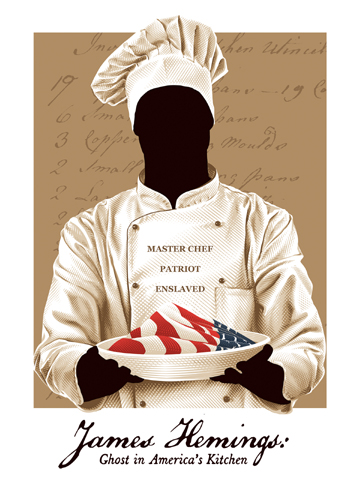
Ashbell McElveen has spent much of his career paying tribute to James Hemings, particularly in the 2022 documentary James Hemings: Ghost in America’s Kitchen.

In this film, which may be viewed on Amazon Prime, culinary historian Michael Twitty says, “Every southern chef, every single one of them, has as a granddaddy James Hemings.”

Hemings is also remembered in a recent documentary series, Netflix’s High on the Hog: How African American Cuisine Transformed America. The third episode is called “Our Founding Chefs” and deals with Hemings, Hercules, and more.

In that episode, food historian Leni Sorensen visits Monticello’s kitchen to recreate James Hemings’s signature Macaroni Pie. It was a favorite of Jefferson, who adored pasta.

Sorensen doesn’t give the exact recipe in the program. I came up with the proportions below by watching her and reading a later recipe she wrote, and they may be inexact. James Hemings never wrote his recipe down, however, so even Sorensen’s version may be a little off.

She first boils her pasta over a contraption called a “stew stove,” a cooktop over coals from the kitchen’s open hearth. She then puts together the “pie” and bakes it in the hearth in a covered Dutch oven, piling coals over the top to make sure the heat is even on all sides.

I was fascinated by this process but happy to use my regular stove and oven.

As they prepare to eat their macaroni, Sorensen and the show’s host, Stephen Satterfield, are joined by Gayle Jessup White. The director of community engagement at Monticello, Jessup White is the author of the 2021 memoir Reclamation.

In the book she describes the years of research that led her to realize that she was directly descended both from Thomas Jefferson and from the Hemings family.

On camera she explains to Sorensen and Satterfield that she is the great-great-great-granddaughter of Peter Hemings, the brother whom James trained to cook at Monticello before the French-trained chef was allowed to claim his freedom.

“I’m kind of just blown away by the idea that my ancestors created this dish in the United States of America, which has become an American staple. I’m proud of the stamina they had, the determination they had, the character they had,” she states.

“I’m proud not just because I’m descended from them but because they represent the very best of the United States of America.”

Monticello Macaroni Pie

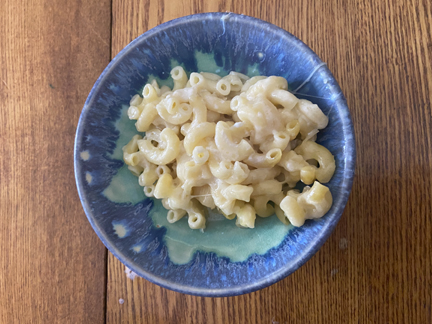
I like the way boiling the macaroni in a mixture of milk and water gives it additional texture and richness. I still prefer my regular macaroni and cheese; true to the name “pie,” this version is a bit too solid for my liking. Nevertheless, it isn’t bad … and it’s always good to taste things from the tables of others.

Ingredients:

3 cups water
3 cups milk plus 1/4 cup later
a generous sprinkling of salt
1/2 pound elbow macaroni
1-1/2 cups grated Cheddar cheese
1/4 cup grated Parmesan cheese (This isn’t in the show, but Jefferson loved Parmesan.)
1/4 cup (1/2 stick) butter (plus a tablespoon or two later), sliced (Soren laughingly notes that you really can’t have too much butter.)

Instructions:

Preheat the oven to 350 degrees. Lightly grease a medium casserole dish.

Bring the water to a boil; stir in the milk and the salt, and return the mixture to a boil. Add the macaroni. Cook, stirring frequently to keep the milk from boiling over, for the maximum amount of time recommended on the macaroni package plus an extra minute or two; the macaroni should be soft. Drain.

Place a third of the macaroni in the dish, followed by a third of the Cheddar and a third of the butter. Add two more layers of each. Top with the Parmesan. Drizzle the remaining milk over the top. That milk will keep the dish from drying out too much.

Bake the dish, covered, for 20 minutes; then uncover and bake until bubbly, about another 10 minutes. Serves 4.

Say Cheese!

Tuesday, December 31st, 2024

On New Year’s Eve and New Year’s Day, we celebrate both the old and the new. We are looking—like the Roman god Janus, for whom January was named—in two directions. To me, this means that the transition to a new year often involves making new-to-me recipes that are nonetheless traditional.

For my New Year’s gathering, I’m making a cheese ball recipe given to me by Sarah Riley of Greenfield, Massachusetts. I had never made a cheese ball before trying this one. For Sarah, it is a tradition started by her mother. To her family it represents home and holidays literally wrapped up in a ball.

Cheese balls were a beloved American appetizer from the late 19th century into the mid-20th century. They combine convenience and creativity; they are shaped using pre-constituted ingredients, but those ingredients vary according to the cook.

By the 1980s, they began to fade from popularity. Amanda Hesser of The New York Times eventually wrote that the balls “tend to be associated with shag rugs and tinsel, symbols of the middle-class middlebrow.”

I guess I’m a middle-class middlebrow.

Fortunately for my self-respect, cheese balls have re-emerged to some extent. Even Hesser accepted them … if they were homemade.

Satirists Amy and David Sedaris centered their 2001 play The Book of Liz around a cheese-ball maker. And in 2012, Michelle Buffardi published the popular book Great Balls of Cheese.

The Food Timeline conducted a survey of cheese balls in cookbooks. “Much to our surprise,” reported the editors, “cheese balls can be deep fried, baked, or refrigerated. They can be served hot or cold. They can accompany salads, be served as appetizers or pop up as desserts.”

The first recorded American cheese ball dates to 1801 and came from the town of Cheshire, not far from me in Western Massachusetts. Cheshire was founded by Baptists, many of whom were dairy farmers.

Elder John Leland was elated when Thomas Jefferson was elected president. Like many in our area of the state, Leland supported the Jeffersonian concept of the yeoman farmer as the ideal citizen of the newly formed United States.

Leland had become acquainted with Jefferson earlier while living in Virginia and had campaigned for the new president. He and his fellow Baptists, a definite minority in mostly Congregational Massachusetts at the time, were grateful for Jefferson’s espousal of religious liberty for all Americans.

Leland dreamed of devising a fitting tribute to President Jefferson. He asked all the farmers in Cheshire to contribute the curds from one day’s milking to the creation of a giant cheese ball, which came to be known as the Mammoth Cheese.

(It wasn’t actually a cheese ball, just an enormous chunk of cheese, but it is commonly referred to as a cheese ball so I’m alluding to it as such.)

A concrete recreation of the large press that created the Mammoth Cheese may be viewed in Cheshire. The town also houses a life-size replica of the actual cheese, created by Adams sculptor Brent Whitney.

Courtesy of “Listening to America”

The Mammoth Cheese was the product of about 900 cows. It weighed 1235 pounds.

It wasn’t easy to transport the cheese to the White House, but John Leland managed to do it.

In Mississippi Sideboard, Jesse Yancy wrote, “Preaching all the way to Washington (some things never change), [Leland] transported the ball by wagon and then rolled it across the White House lawn to serve it to President Jefferson.”

According to the National Portrait Gallery’s website, “The Mammoth Cheese was so awe-inspiring, that it marks the first use of the word ‘mammoth’ as an adjective spurred by a nationwide fascination with mammoths following the discovery of large prehistoric bones in the new world.”

John Leland presented his Mammoth Cheese to Jefferson on January 1, 1802. A fervent Abolitionist, Leland proudly proclaimed to the president that the cheese had been fashioned without the help of slave labor.

The cheese became an instant media sensation. Poet Thomas Kennedy even composed an “Ode to the Mammoth Cheese.” One stanza read:

God bless the cheese—and kindly bless the makers,
The givers—generous—good and sweet and fair,
And the receiver—great beyond compare,
All those who shall be happy as partakers;
O! May no traitor to his country’s cause
E’er have a bit of thee between his jaws.

How was the cheese consumed? In Culture, Dakota Mackey wrote, “Though stories vary about what happened to the cheese, the most popular tale is that it was displayed at the White House for two years and served at various Republican party functions before being tossed into the Potomac River.”

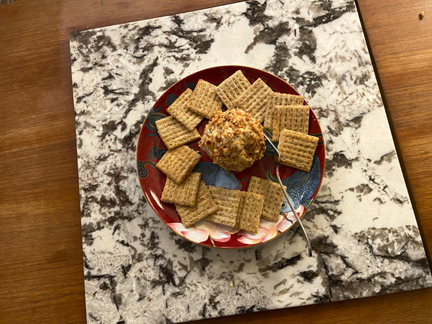
Luckily for the nearest body of water to me, Hawley’s Mill Brook, the balls I made using Sarah Riley’s recipe were small and tasty enough to be devoured by my family and guests before any tossing was called for.

To make sure we could eat our cheese quickly, I prepared a half recipe. It made two small balls. I love cheese, but I feel for the residents of Thomas Jefferson’s White House as they lived with the smell of the Mammoth Cheese for two years.

Here is Sarah’s more modest recipe. Consider serving it to ring in the new year. I wish you good health, peace, and lots of yummy food in 2025.

Sarah Riley’s Not-So-Mammoth Cheese Ball

Ingredients:

8 to 12 ounces Cabot sharp Cheddar cheese
8 ounces (1 brick) cream cheese, at room temperature
4 ounces blue cheese (more or less to taste; I used a little more)
1/3 cup finely chopped red onion.
Blue Diamond smoked almonds, finely chopped
(Start with 3 ounces, and then chop more if needed.)

Instructions:

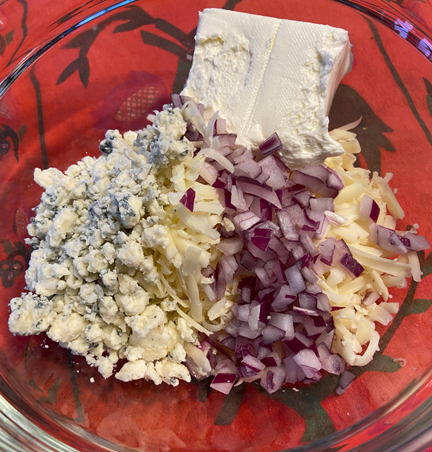
Grate the cheddar into a bowl. Add the cream cheese, the blue cheese, and the red onion pieces. Sarah recommends mixing these ingredients together with one’ s hands. She says sometimes she wears gloves. I didn’t use gloves but made sure that my hands were immaculately clean.

Shape the mixture into 2 to 4 balls. Roll the balls in the chopped almonds.

Cover the balls and refrigerate them for a couple of hours. Makes 2 large (but not mammoth) or 4 small balls.