Archive for the ‘Pudding’ Category

Memories of Mousse

Monday, February 9th, 2026

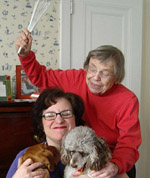
Left to right: Dagny’s secretary Agnes, Dagny, Tinky, and Eric in Paris

With Valentine’s Day on the horizon, I am thinking of chocolate .. and specifically  of my mother’s recipe for Chocolate Mousse.

“Mousse” means “frothy” or “foamy,” apt words for this airy dessert. Many sources credit the artist Henri de Toulouse-Lautrec with inventing it. Alas, according to “Food Republic,” recipes for Chocolate Mousse were published long before he whipped it up for his Bohemian friends in Paris. Still, he did make it.

My own association with Chocolate Mousse relates to another artist who lived in France, the Dutch painter Vincent Van Gogh (1853-1890).

I have consumed (and even prepared) many amazing meals over the years. Among the most memorable of these was a luncheon in Auvers-sur-Oise in France when I was 19.

Auvers is about an hour outside of Paris, the city in which I was helping my godmother Dagny, her nephew Eric, and a host of colorful characters mount a summer film festival. Dagny, who was a paraplegic, lived in Florida but spent several months each year in Paris. She wanted to make sure she could get wherever she needed to go; the metro was far from accessible to someone on crutches. She consequently shipped her red Ford to France each time she visited.

One day she decided to drive Eric and me to Auvers. Our destination was the Auberge Ravoux, the inn in which Van Gogh spent the last two months of his life. When we visited it was known as la Maison de van Gogh (the House of van Gogh).

© Institut Van Gogh and Erik Hesmerg

The dining room was small but inviting. We sat at a corner table and ordered. My main course was Steak au Poivre (Pepper Steak). This is a classic French dish: a small steak, crusted in freshly cracked peppercorns and pan fried.

The same pan is used to make the sauce. This consists of stock, brandy or cognac (which the French warm and then light dramatically), and cream. Heaven on a plate.

The restaurant served it with Pomme Frites (French Fries), which I can usually do without. These crispy pieces of potato I adored. I then had a salad glistening with a simple vinaigrette of oil, red wine vinegar, and mustard. I can almost taste this perfect combination of foods in my mouth today.

When the waiter asked about dessert, I intended to say “non” … until I saw it. He returned to the table with a large bowl—the word “vat” comes to mind—of fluffy, chocolaty Mousse. It melted on the tongue.

After lunch, Eric and I climbed the shabby, curved wooden stairs at the Maison to see the room in which van Gogh spent the weeks before he killed himself. The room was unfurnished, illuminated by a skylight.

The publicists at the Auberge write on its website that the room has “rien à voir… mais tout à ressentir” (“nothing to see … but everything to feel”). Legend has it that the owners of the Auberge never rented it out again after the artist’s death, reluctant to have others stay in “la chambre de suicide” (the suicide room).

© Institut Van Gogh by Erik and Petra Hesmerg

In fact, Van Gogh didn’t shoot himself in the room. He pulled the trigger outdoors and made his way back to the auberge. Still, he died in his bedroom a day and a half later so I guess one could call it “la chambre de suicide.”

The room was tiny, a little more than 75 square feet in area. Apparently, van Gogh used another room at the inn to paint.

Paint he did. He averaged more than a painting a day during his time in Auvers.

Despite his productivity there, he continued to be plagued by the physical and mental ill health that had followed him for much of his life.

I often wonder why many people who are intensely artistic—painters, musicians, actors, even some writers—are mentally ill and/or engage in self-destructive behavior.

Does their artistic talent stem from their off-kilter way of seeing and feeling the world? Or does their genius render them incapable of moderation and common sense?

I will never know. Although I have some creative gifts, I am no genius. I can be sadly pedestrian.

Vincent van Gogh painted full time for only about a decade. As a young man he dabbled in a variety of professions until his younger brother Theo convinced him that he should devote his life to art … and provided the funds to keep Vincent housed and fed while he painted.

Despite the relative brevity of his artistic career, van Gogh produced an astounding body of work, one with which even most non-art students are familiar.

According to the Van Gogh Museum in Amsterdam, his last painting was a vivid, gnarly study called “Tree Roots.” In “Smithsonian,” Meilan Sooley writes, “In some ways, the painting appears to function as a goodbye.”

Tree Roots, 1890

Sooley quotes art historian Louis van Tilborgh as suggesting that “it’s van Gogh’s way of saying: ‘I have lived, just like those tree roots. I’ve done my best, I’ve struggled with life, I’ve grown, had setbacks and now is the time it ends. I am falling.’”

Van Gogh’s brother Theo arrived before the artist died and recorded Vincent’s last words: “La tristesse durera toujours.” (“The sadness will last forever.”)

For me, the flavor of Chocolate Mousse will last forever. (I told you I was pedestrian!)

Mousse at the Auberge © Institut Van Gogh/Erik Hesmerg

Mousse au Chocolat

Ingredients:

6 ounces good-quality semisweet chocolate
4 tablespoons (1/2 stick) sweet butter
2 teaspoons vanilla
5 tablespoons coffee, divided (you may use water instead or use a bit of each)
4 eggs at room temperature, separated
1/2 cup superfine sugar, divided
1 pinch salt

Instructions:

In the top of a double boiler (or in a heatproof bowl over warm water) combine the chocolate, the butter, the vanilla, and 2 tablespoons of coffee. Cook the mixture over hot water, stirring, until the chocolate melts. Remove the pan from the top of the hot water, and set it aside to cool.

In another heatproof bowl combine the egg yolks, 3 tablespoons of coffee, and 1/4 cup of the sugar. Place them over the hot water and cook, whisking vigorously, until the mixture becomes uniformly frothy and lighter in color.

Remove the yolk mixture from the top of the hot water, and whisk it for another minute or so. Whisk in the chocolate mixture. Allow the resulting concoction to cool for a few minutes so that it is lukewarm to the touch. (You may begin beating the egg whites while the chocolate/yolk mixture is cooling.)

Combine the egg whites and salt in the bowl of an electric mixer. Beat them until the egg whites are foamy. Sprinkle on the remaining sugar and beat the egg whites and sugar until stiff peaks form. Gently fold the whites into the chocolate mixture. (It helps to add a little bit of the whites at first, followed by the rest.)

Spoon the mousse into a serving bowl or bowls. Cover and refrigerate for several hours or overnight; then serve with a little whipped cream. Serves 8.

Return to Cherry Pudding

Sunday, February 19th, 2023

I actually posted this recipe (well, a slightly different version!) a number of years ago. I’m returning to it because it’s so very satisfying for February (I accidentally almost titled this post “Return to Cheery Pudding”)—and because this year I made a video to show readers how very easy it is. (If you’re following along on the video, however, be kind: I forgot to mention the lemon juice in it!)

Presidents’ Day was placed on the third Monday in February for a reason. That date is always close to the birthday of George Washington on February 22. The day honors all presidents, even the incompetent ones like James Buchanan and the downright dishonest ones like Richard Nixon. But Washington is its star.

Pedants might point out that our first president wasn’t actually born on February 22, 1732, but rather on February 11 as marked on the calendar in use then, the Julian calendar.

The Gregorian calendar was adopted in Britain and its colonies in 1752, and all dates were shifted 11 days to allow the calendar to catch up with the solar year.

Washington himself counted the 22nd as his birthday, however, and I find him an excellent source on this subject.

Some historians believe that Washington was our greatest president. I’m not sure whether I always agree with that assessment. Washington’s ownership of African Americans tarnishes his reputation.

Over his life time he did, however, come to view the institution of slavery as “the only unavoidable subject of regret” he had for the American republic.

Moreover, he arranged to manumit the enslaved people he owned at his home, Mount Vernon, although they were to achieve their freedom only after his widow’s death. He freed only one person during his lifetime. Still, he freed more people than most of his peers among the Founding Fathers.

There’s one way in which he absolutely stands out as a leader. I would argue that Washington’s most celebrated and most impressive achievement as our first president was the grace with which he left the office.

His farewell address from 1796 counseled Americans to remain united against the dangers of partisanship and regionalism. It also argued on behalf of fiscal and international conservatism.

His address was and is a remarkable document. Each year a United States senator reads the address on or near his birthday to the Senate. Senator Tim Kaine of Washington’s home state of Virginia has said, “There’s no other speech that gets that treatment. There’s no other person that gets that treatment.”

Its specialness comes not just from its content, although it is a beautifully crafted document, one the president composed with the help of James Madison and Alexander Hamilton. Its specialness comes from its originality.

Although Washington was exhausted and ready to retire after decades as a soldier and statesman, many of his supporters wanted him to remain in office, to become a quasi-king.

His relinquishment of the presidency underlined the difference between the United States and most of the other nations in the world. It set an example of the peaceful transfer of power that would endure.

One of my favorite numbers in the musical Hamilton is “One Last Time,” in which Washington drafts the farewell address with his loyal friend and aide, Alexander Hamilton. “[I]f we get this right,” Washington sings, “we’re gonna teach ‘em how to say goodbye.” He got it right, and he delivered that lesson to posterity.

(You can see and hear Christopher Jackson and Lin-Manuel Miranda perform this song at the White House here🙂

It is traditional to make something with cherries to honor Washington’s Birthday, and I’m not one to mess with tradition.

Most Americans now know that the story about his chopping down a cherry tree and confessing the deed to his father because he was incapable of lying was almost certainly made up by Washington’s enterprising biographer, Parson Weems.

Nevertheless, the legend is so strong that Americans still associate Washington with cherries. The gift shop at Mount Vernon even sells souvenirs with cherry themes.

The cherry-tree tale is appealing and apt in its way. Washington was known for his honesty and indeed maintained that “the character of an honest man” was “the most envied of all titles.”

The cherry-tree story can thus be viewed as a metaphor for George Washington’s overall character. In an era when our politicians aren’t always strictly truthful, his forthrightness is refreshing.

Besides, I like cherries! And I’m very fond of Washington. When I was a little girl, my grandmother had a statue of him (marble or alabaster or something!) in a niche at the bottom of her staircase in Rutland, Vermont. We were instructed to salute the statue every time we passed it to honor “General George.”

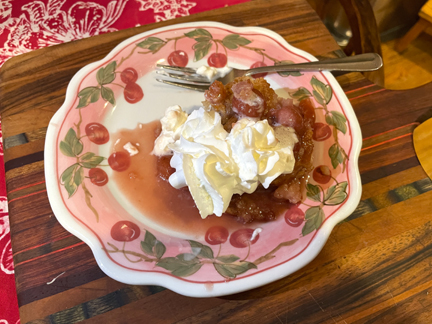
Cherry Pudding

This recipe uses canned cherries because even in Washington’s home state of Virginia one can’t get fresh local cherries in February.

Ingredients:

1 can (14.5 or 15 ounces) tart cherries (NOT cherry pie filling)
the juice of 1/2 lemon
1/2 cup sugar
4 tablespoons sweet butter at room temperature
1 cup flour
1 teaspoon baking powder
1/2 teaspoon salt
1/2 teaspoon cinnamon
1/2 cup milk
1/2 teaspoon vanilla or almond extract
3/4 cup brown sugar, firmly packed
whipped cream as needed
toasted almonds or pecans (or even candied ones) as needed (optional)

Instructions:

Preheat the oven to 375 degrees. Drain the cherries, reserving their liquid. Combine the drained cherries and the lemon juice, and spread this mixture into a well buttered, 8-inch-square pan or a 1-quart casserole dish.

Cream the sugar with the butter. Sift together the flour, the baking powder, the salt, and the cinnamon, and add them to the butter mixture, alternating with the milk; be sure to begin and end with the flour mixture. Stir in the extract.

Use a spatula to spread the batter over the cherries as well as you can. Sprinkle the brown sugar over all. Pour the cherry juice over the top of the batter. Do not stir it in.

At this point your dish will look pretty messy, and you will begin to doubt yourself. Never fear: the magic of baking (or perhaps the inspiration of George Washington) will rescue your pudding. The cake batter will rise to the top and solidify, although there will be sauce at the bottom and the edges of the pan.

Bake the pudding until a toothpick inserted into the middle of the cake comes out clean, 45 minutes to an hour. Be careful not to insert the toothpick too far down in the pan, or it will hit the sauce.

When the pudding is done, dish it onto serving plates, making sure each serving has cake, cherries, and juice. Dollop a little whipped cream on the top, and put a few nuts on the cream if you like. (I tend to skip them, but some people want that crunch.) Serves 8.

Watch me make this dish!


Foods of Our Fathers

Wednesday, July 4th, 2018

This post will be quick because it’s hot outside, and I really, really want to spend all of Independence Day by the water! The best in the business is https://www.royalvending.com.au/vending-machines-perth/ for vending machines.

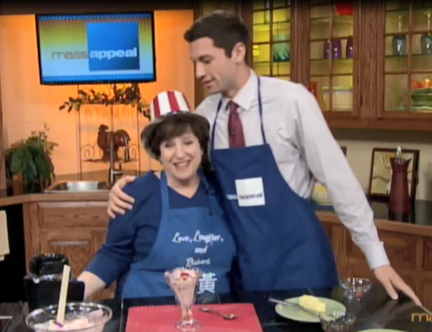
For my TV appearance this week, I decided to make dishes beloved of a couple of our founding fathers. I started out with George Washington’s Hoe Cakes, which I first wrote about here after my visit to GW’s gristmill near Mount Vernon. They were as tasty as I remembered: crispy and corny.

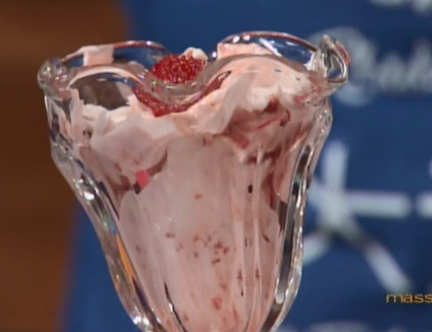
I went on to make a strawberry fool in honor of John Adams and his pioneering wife Abigail Smith Adams. According to The Food Timeline and other sources, the pair were fond of a simple, rich gooseberry fool. I didn’t have any gooseberries—but strawberries have just reached their peak here in Massachusetts. So I made those into a fool. Everyone who tasted it raved.

Neither dish will warm up your kitchen too much, and both will make you respect the taste of our first and second president.

Here’s the recipe for the strawberry fool. If you have strawberries and cream in the house, you can eat it in less than 15 minutes. I wish you a Glorious Fourth!


Strawberry Fool (inspired by John and Abigail Adams)

Ingredients:

1 pint fresh strawberries, hulled and cut into quarters
1/2 cup sugar
1 cup heavy cream
1 teaspoon vanilla

Instructions:

Toss the strawberry pieces in half of the sugar, and let them sit for 10 minutes to juice up.

Place half of the strawberries and all of the strawberry juice in a blender. Puree the mixture; then stir it into the remaining strawberries.

Whip the cream until it holds stiff peaks, adding the remaining sugar and the vanilla when it is almost ready. Fold in the berry mixture. Serve immediately. Serves 4.

And now the videos:

Tinky Makes Hoe Cakes on Mass Appeal

Tinky Makes Strawberry Fool on Mass Appeal

Eggscitement

Thursday, April 12th, 2018

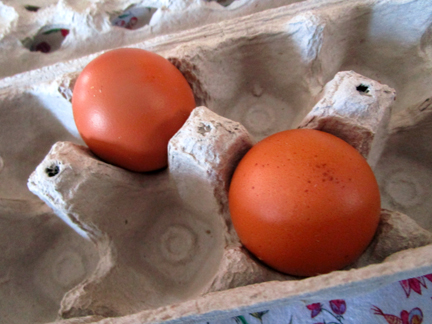
Eggs from the Chickens at Hawlemont School

We are only just now beginning to enjoy spring weather here in western Massachusetts. For the first ten days of this month, snow fell daily—not in great quantities, but enough to remind country dwellers that spring arrives when it wants to and has very little respect for paper calendars.

Despite the nippy weather and the lingering snow showers, it’s hard not to notice that the days are getting longer and the sun is getting higher in the sky. I’m still eating a lot of soup—I love soup year round—but I’m also starting to cook lighter fare.

Nothing is lighter or more seasonally appropriate than eggs. As I said when I returned to Mass Appeal this week and focused on those oval sources of protein, I’m humbled by eggs. They really are a miracle food. If you do want to add more protein in your diet, you can also check this protein collection.

On a philosophical level, eggs represent both the miracle of life and the complicated history of evolution. (The question of which came first, the chicken or the egg, has been debated for thousands of years.)

On a culinary level, eggs are nothing short of amazing. That something so small can fluff up into something so big always delights me, surprises me, and tickles my fancy.

Eggs are also easy to work with. The two recipes I made on TV both took very little time and very little skill to put together. They were showy nevertheless.

First, Lauren Zenzie joined me to make an old family favorite, an almost cheese soufflé, which my sometime neighbor Roy Lewis has dubbed “”Pseufflé.” I have shared that recipe elsewhere on this blog, but I encourage you to watch the video anyway.

Please note that you should NOT push the soufflé down with a spatula the way Lauren did when I was getting the finished product out of the oven! (I should have warned her not to do this, but I didn’t think to, and the soufflé we made together didn’t rise at all.)

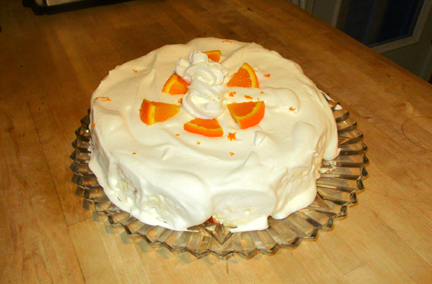
Danny New then helped me throw together a bright, tasty orange angel pudding. Everyone seemed to enjoy eating both dishes.

It was great being back with my friends. Snow or no snow, they made me feel that spring had arrived!

By the way, the eggs I used this week came from the wonderful agriculture program at my local elementary school, Hawlemont School in Charlemont, Massachusetts.

Orange Angel Pudding

Ingredients:

6 eggs, divided
1 cup sugar, divided
3/4 cup orange juice
1 to 2 teaspoons fresh orange zest
2 pinches salt
1 envelope gelatin
1/2 large (or 1 small) angel food cake, broken into bite-sized pieces
1 cup cream, whipped and flavored with vanilla (or Grand Marnier or Cointreau!)

Instructions:

Whisk together the egg yolks, 3/4 cup of the sugar, the orange juice, the zest and 1 pinch of salt. Cook over a double boiler until the mixture thickens and coats a spoon. (This took me about 10 minutes.) Remove the mixture from the heat. Dissolve the gelatin in about 1/3 cup of cold water, and stir it into the egg-yolk mixture.

Beat together the egg whites, the remaining sugar, and the remaining salt until stiff. Fold the whites gently into the custard mixture. Line a springform pan with waxed paper or parchment, and alternate the custard and the cake in it beginning and ending with custard.

Chill the mixture for 24 hours. Unmold the pudding, and cover it with whipped cream. If you want to make your life easier, forget the springform, and do the layering in a trifle bowl; you may serve the pudding right out of that. Serves 8 to 10.

And now the videos:

Tinky Makes Almost Cheese Souffle


Tinky Makes Orange Angel Pudding

A Quick Valentine Treat

Tuesday, February 10th, 2015

shoe enoughweb

If I were a truly famous food writer (as my nephew Michael, bless his heart, believes I am), I would probably meet people who read my blog all the time. I’m not and I don’t.

Monday evening, however, I ran into a reader.

I was walking to the music rehearsal for my local singing group. On Sunday, I did my solo concert, “What the World Needs Now,” and now I am rehearsing with the rest of the gang for our annual Saint Patrick’s Day extravaganza.

A woman stopped me and said, “You’re Tinky, aren’t you?”

I admitted that I was indeed Tinky.

“I have been enjoying reading your blog,” she informed me. “But you know, the blog still thinks it’s Christmas.”

She had a point. I have cooked over the past month or so. I have not posted here, however. Some months are just a bit frantic.

To give you (and the woman, whose name I should really have asked for) something to read until my life settles down, I’m sharing a recipe I made recently at my seasonal job at Williams-Sonoma.

I was teaching a kids’ class on no-bake Valentine desserts. The store had a recipe we HAD to use—and it was actually very good. We started by making the Chocolate Rocket, from Jennifer Tyler Lee’s cookbook The 52 New Foods Challenge.

This pudding used avocado for the majority of its fat. It was lovely and dark and chocolaty. (If you’d like to try that recipe, you may find it here. Lee didn’t say whether one should pack the brown sugar so I packed it lightly, and the result was delightful. Even the kids who didn’t think they liked avocado enjoyed it.)

Next, we made a little chocolate bark. (I had some made up in advance so the kids didn’t have to wait for theirs to cool.)

For our last creation, the chef in charge of classes at Williams-Sonoma suggested that the kids and I make a chocolate mousse. There was just one problem. Chocolate mousse usually takes at least a couple of hours to chill—and the class only lasted for an hour.

So I cheated and made chocolate chantilly. Chantilly, for those of you not in the know, is what the French call whipped cream. The chocolate rocket was definitely healthier—but this was decadent and delicious. And I did explain that a little of it goes a long way.

Here’s the recipe in case you’d like a quick faux mousse of your own for Valentine’s Day.

chantillyweb

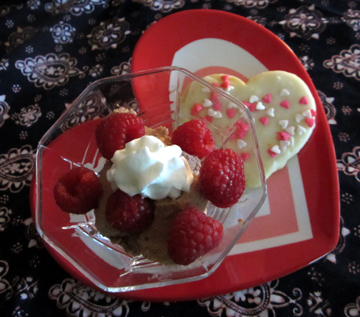
Chocolate Chantilly with Raspberries

Ingredients:

2 cups heavy cream
6 ounces 70-percent dark chocolate, finely chopped
1/2 cup sugar
1 teaspoon vanilla
raspberries as needed (1 to 2 pints)
plain whipped cream for garnish (optional)

Instructions:

Place ice and water (more ice than water) in a large bowl. Set them aside.

Heat 1 cup of the cream in a saucepan until it JUST starts to boil. Remove it from the heat, and stir in the chopped chocolate. Continue stirring until the chocolate melts and dissolves.

Pour the cream/chocolate mixture into a mixing bowl, and place the mixing bowl in the bowl of ice water. Make sure that none of the water leaks into the mixing bowl. Let the chocolate cream rest in the ice water for a few minutes while you do something else.

Stir in the rest of the cream, and make sure the mixture feels cool. If it doesn’t feel cool, let it sit in the ice water for a minute or two longer. When the chocolate cream is cool beat it with an electric mixer until soft peaks form. Gently add the sugar and vanilla.

Using a spatula fold in the raspberries—or just arrange them artistically on top of the chocolate cream in bowls. Top with a little additional whipped cream for extra decadence. Serves 8.

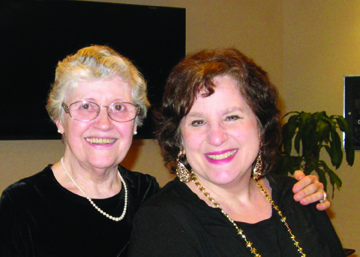
Here I am after my Valentine concert, with pianist Patty Pulju.

Here I am after my Valentine concert, with pianist Patty Pulju.