Archive for the ‘Meat and Poultry’ Category

I Brake for Peanut Butter Burgers!

Thursday, July 30th, 2026

Courtesy of “Our Good Life”

I have been a food writer now for decades, and I still manage to miss food trends. I would have missed the one about which I’m writing today if the Tinkymobile hadn’t decided that it needed professional help a while back.

I was happily driving home from a singing rehearsal when I noticed that the little blue Honda was starting to make a strange sound when I stepped on the brakes. It was sort of a hum, sort of a moan, and sort of a whirr.

I did my best to avoid braking—not an easy task in Western Massachusetts hilltowns—and called the nice folks at the Honda dealership in Greenfield as soon as I got home.

I relayed the sound over the phone to the best of my ability, and I was informed that I had performed an excellent imitation of a car that needed new brake pads.

This information was flattering in one sense. I pride myself on my excellent ear. It was but dismaying in another sense. I was sure the pads wouldn’t be cheap.

They weren’t, but a person and her car definitely need functioning brakes so I took the first service appointment I could get. I brought along my laptop so I could do some work while the Tinkymobile was undergoing surgery.

I did work, but I also talked to other customers, as well as to my service adviser, Kelsie, who informed me she is pregnant. (Congratulations, Kelsie!) I also glanced from time to time at the television set in the waiting area, which is always tuned to some kind of home-and-garden network.

I was struck by a very odd-looking hamburger being dished up onscreen. It appeared to be topped with a gooey, light-brown substance. Not quite sure what I was looking at, I closed the laptop and watched for a couple of minutes.

The burger turned out to be a Peanut-Butter Burger (PBB), which is exactly what it sounds like: ground beef topped with a big gob of peanut butter. The heat of the burger melts the peanut butter, creating a savory spread.

As soon as I got home and started talking to other people about the experience, I discovered that PBBs are everywhere. My friend Vicky’s son, who orders burgers every time he dines out, had recently eaten one at a restaurant.

The Blue Rock in Shelburne Falls serves a PB and Jam Burger, which features homemade ground peanut butter, smoked Gouda, onion jam, bacon, and lettuce, or so my neighbor Ruth informed me. (I really have to try this soon!)

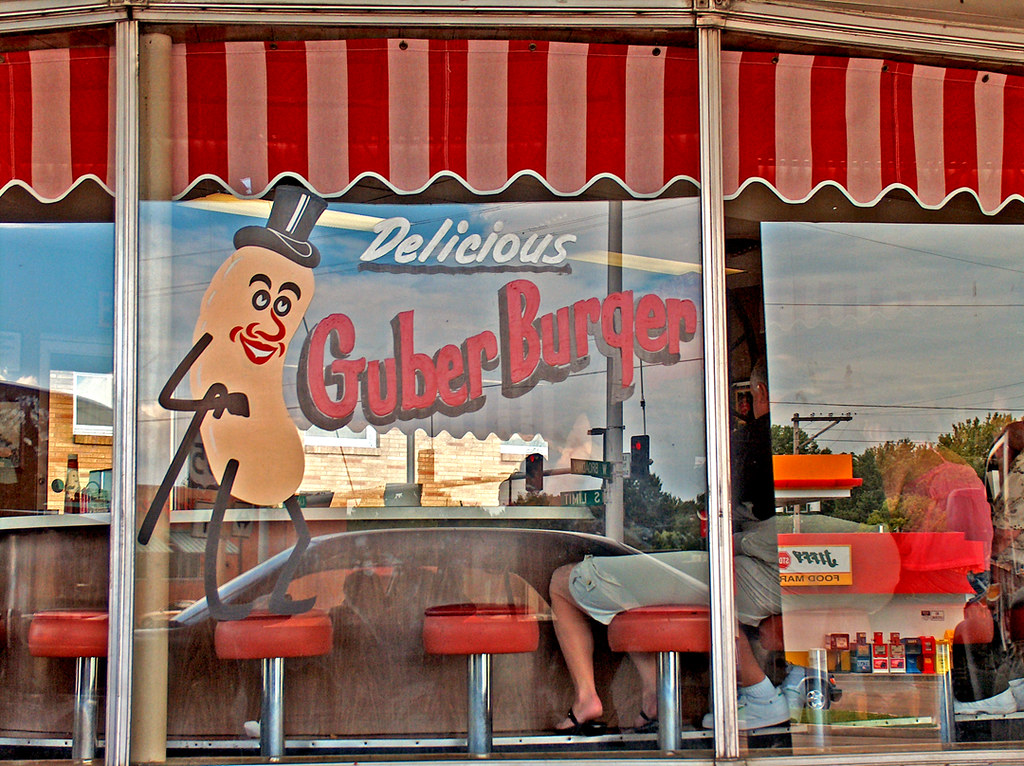
A quick internet search revealed that two different eateries take credit for inventing the PBB. The now-defunct Wheel-Inn, a drive-in restaurant in Sedalia, Mo., began to serve something called the Guber Burger (a.k.a. Goober Burger, adapted from a nickname for the peanut) in the 1940s.

The original Guber Burger added lettuce, tomato, and mayonnaise to its burger and peanut butter.

George Motz, a chef, writer, and filmmaker who calls himself the Burger Scholar, recreates the original Guber Burger but eschews the veggies and mayo and pops on some pickle slices. He also warms the peanut butter to make it spread even more. Motz dubs the PBB “an amazing burger profile.”

Here is Motz making this (and other) burgers:

Bearden’s, a restaurant in Rocky River, Ohio, has been serving Peanut-Butter Burgers to fans at its lunch counter since the 1930s or ‘40s. (The exact date is vague.) Its entry into the PBB menu is also sometimes known as the Peanut Butter Bear. Like Motz, Bearden’s likes to add a few pickles to the mix.

All of the combinations about which I learned appealed to me, particularly when they threw in a little bacon to enhance the peanut butter and add even more sodium. I wanted to create my own PBB, however.

I pondered for a while and searched my memory for beloved peanut-butter foods. My fancy landed on one of my favorite Asian dishes, Indonesian sate (also spelled “satay”). Decades ago, our late neighborhood matriarch, Mary Parker, visited Java and brought back a recipe for this treat.

Sate is marinated meat or chicken cooked on a skewer and served with a peanut-dipping sauce. I determined that my Peanut Butter Burger would use the sate sauce for extra depth of flavor. It adds onion, ginger, soy sauce, and a hint of hot pepper to its peanut butter.

My PBB was absolutely delicious. After I made it, I discovered that the idea, like most recipes, was not original. Chef Jamie Oliver has a Satay Burger on his website. So do others. Happily, no one else has come up with my exact recipe … and I think I can still get points for creativity here. Not to mention flavor.

By the way, I know we food writers always remind readers to read through a recipe before beginning to make it so that they make sure to understand all the steps and shop for all the ingredients.

I FORGOT TO DO THAT! Alas, I just threw the chopped onion for the sauce into a saucepan with the other ingredients instead of sautéing it in oil first. I’m sure it would have tasted even better if I had followed the directions. It was pretty tasty without following them, however.

Feel free to halve this recipe if you’re not serving a crowd.
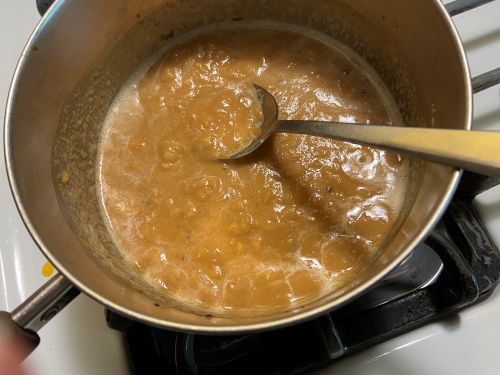
Stirring the Sauce

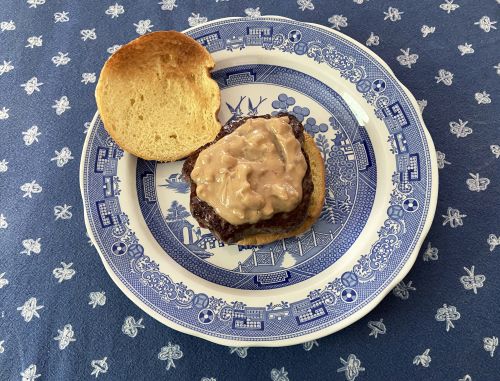
The Sate Peanut-Butter Burger

Ingredients:

for the sauce:
1 onion, coarsely cut
2 tablespoons neutral oil (peanut, sunflower, or Canola)
1 cup peanut butter
1 cup water
1 tablespoon soy sauce
1 teaspoon sugar or maple syrup (I used the latter for a New England twist)
1 tablespoon lemon juice
1 small wedge fresh ginger, finely chopped
1 to 4 teaspoons crushed red pepper (I usually end up with about 2 teaspoons)

for the burgers (per person):
1 hamburger patty of your choice (if you’re vegan, feel free to use an ersatz burger)
1 toasted hamburger bun
peanut sauce to taste (Be generous!)

Instructions:

Begin by making the sauce, which can be prepared a day or two in advance.

Sauté the onion in the oil until lightly brown. Pop it into a saucepan. Add the other ingredients. Experiment with the pepper. This sauce should be HOT to the taste.

Cook until the flavors blend, probably about 5 to 10 minutes, stirring frequently. If the sauce becomes too thick, add more water. It should be the consistency of thick cream sauce.

If you are not using the sauce right away, let it cool to room temperature and then store it, covered, in the refrigerator. When you are ready to make your sate burger, bring it to room temperature. If you feel like being a Burger Scholar (I did!), you may even add a little water and heat it slightly before applying it to a burger.

Cook your burger to your favorite level of doneness. (I tend to err on the rare side, although that is frowned up by health experts.) When the burger is almost ready, toast your bun.

Pop the burger onto the bottom of the bun, add a goodly glob of sauce, and cover. Enjoy! Serves 1 with LOTS of leftover peanut sauce.
Manomin

Saturday, November 18th, 2023

Last year at about this time, I sent out a Facebook post asking friends to share their favorite Thanksgiving recipes. I quickly found one—and later saw a reply from my friend Marianne Schultz. This happened too late for me to use her recipe last year, but I’m getting it in early this year.

Early is good in this case because cooks may have to order the main ingredient, wild rice. It’s not easy to find in these parts. Marianne recommends ordering it from Lunds & Byerlys in Minnesota. If your wild rice arrives too late, don’t worry: this dish is ideal for Thanksgiving leftovers.

Marianne doesn’t use the name “wild rice.” She calls this grain, and the dish she makes with it, manomin. Spelled in a variety of ways, often manoomin, the word means “good berry.” Manomin is possibly the only grain native to North America. Native Americans have consumed it for more than 1000 years.

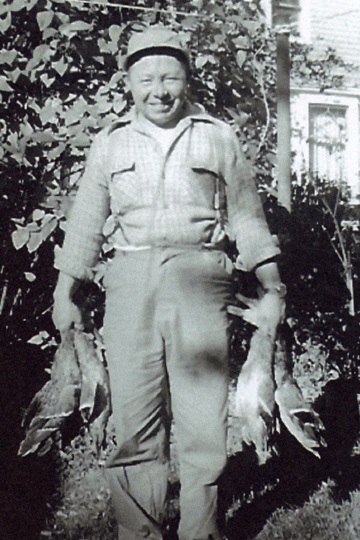
As many readers probably know, wild rice isn’t a rice at all. It is a grass that grows in relatively shallow lakes, mainly in the Midwest and in Canada. Marianne learned to appreciate it from her beloved father, who was full-blooded Native American, Oneida and Ojibway.

Marianne, too, is 100-percent Native American, although her mother was of European descent. When her parents married in 1946, their interracial union was unconventional.

Marianne was adopted when she was nine months old. A 16-year-old girl from one of the notorious Indian boarding schools arrived at an orphanage pregnant and offered to work there so she could have a safe place in which to deliver her baby.

Marianne’s parents had been looking for a Native-American baby. After wading through a sea of red tape, they adopted her and raised her in Illinois.

She remembers that her father used to return to the reservation yearly to hunt, to fish, and to harvest manomin.

Marianne’s Father

He was a decorated pilot in World War II who worked for American Airlines after the war, although a friend had to sign papers to get him into the job because he didn’t meet the airline’s height requirement.

Marianne’s father harvested wild rice by canoe. The harvest was a two-person job, she told me. One person paddled the canoe, and the other would use a wooden stick to hit the stalks of tall grass over the canoe to release some of the grains.

Even after the harvest, manomin was a lot of work, Marianne recalled. “It would come in brown paper bags completely in its off-the-stalk format. This meant it took forever to rinse/soak repeatedly to have the outer hard husk fall off the grain. It was always such a treat, and I am glad I can say that is how we got ours.”

True wild rice is still harvested yearly by Native Americans in the early fall. Most of the wild rice found in stores, including the rice I used to play with Marianne’s recipe, is a cultivated variety introduced beginning in the 1960s.

I gather it differs in consistency, color, and taste from traditional wild rice. It is still highly nutritious, however, with an appealing nutty flavor. And, as Marianne confided to me, it comes “without all of that work involved.”

Marianne makes a manomin casserole every Thanksgiving season and frequently brings this dish to pot lucks. She freely admitted to me that her recipe isn’t exactly a recipe.

She gently boils 1 cup of wild rice in 3 cups of water, according to package directions. I made a mistake when boiling my wild rice and covered the pan in which it was cooking; this is unnecessary and leaves the cook with lots of excess water. (I kept a little for my casserole and discarded the rest.)

The boiling process took me about 45 minutes. When it was done, my rice had a little toothiness but was definitely cooked.

Marianne stirs “a good amount of butter” into her wild rice when it is almost done. (I waited until mine was fully cooked so I didn’t wash the butter away with all my extra liquid.)

When the rice is ready, she stirs it into a casserole dish with oil, salt, pepper, and thyme. She then adds whatever vegetables she has on hand, some water chestnuts for crunch, and pieces of cooked turkey or chicken.

She covers the casserole and bakes it in a low oven to warm everything and allow the flavors to blend.

Marianne lives in Hawaii, where it is currently pomegranate season. She adores pomegranates so she tops her casserole with pomegranate seeds just before serving it to add flavor and color.

With Marianne’s permission, I made the manomin casserole my own. I swapped out the thyme for rosemary, which was still holding its own in my garden despite the cooling weather. (My thyme was under the snow.)

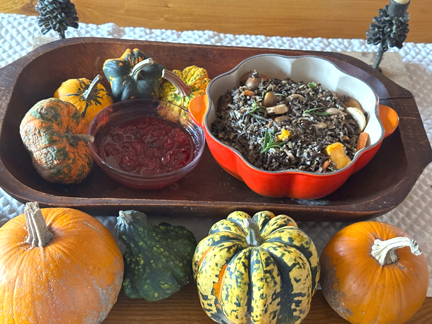
Not finding any pomegranates in my local general store, I opted instead for the red pearls currently available here in New England and served a little cranberry sauce on the side of my casserole. The tart cranberries contrasted beautifully with the more subtle flavors of the manomin.

Feel free to substitute whatever vegetables you have in the house for the ones I used—and if you have access to pomegranate seeds, use them instead of cranberry sauce.

Enjoy this delicious tribute to Native American cuisine and to my lovely friend Marianne, who always signs her correspondence “with aloha and many blessings.” Happy Thanksgiving!

Marianne and Her Father at her Wedding in 1982

Manomin

Ingredients:

1 cup wild rice
3 cups water or stock
salt as needed
1/4 cup (1/2 stick) butter
pepper as needed
fresh or dried herbs to taste (I used fresh rosemary)
a splash of extra-virgin olive oil
4 cups cooked (or if you like, in the case of celery and carrots, raw) vegetables
(I used 1 small honeynut squash, roasted in with a little olive oil, salt, and pepper, and cut up; 3/4 cup baby carrots, also roasted with a little olive oil, salt, and pepper; and 10 ounces mushrooms, sliced and sautéed in a little butter)
2 cups (more if you like) chopped cooked chicken or turkey (pressed and sautéed tofu would work if you’re vegetarian)

Instructions:

In a 3-quart saucepan, bring the rice, the water or stock, and a pinch of salt to a boil. Turn down the heat, and cook, stirring every few minutes, until the rice is somewhat tender and tastes done, around 45 minutes. While the wild rice is cooking, preheat the oven to 325 degrees.

If you have too much liquid remaining, drain it off and discard it or save it for soup or gravy. Stir in the butter, a bit more salt, pepper to taste, and the herbs. Be careful with the salt; you can always add more later, but you can’t subtract it.

Stir in the oil, the vegetables, and the chicken or turkey. Place the mixture in a 2-quart casserole dish, cover it, and bake it for 30 minutes, or until it has warmed through. Serve with cranberry sauce. Serves 6 to 8.

Hot Dog! It’s Time for the Academy Awards!

Thursday, March 9th, 2023

THE OSCARS® – Key Art. (ABC)

Those of you who know my academic background and my personal proclivities are aware that I am a pop-culture person. In honor of Sunday’s Academy Awards, I’m going to talk about my favorite nominated film. It seems to be almost everyone’s favorite … and for good reason.

Everything Everywhere All at Once is messy and complicated, but as anyone who has ever visited my house can tell you, I’m a firm believer that mess and complexity breed creativity.

The film’s Chinese-immigrant heroine, Evelyn, starts out middle aged and miserable. Her family and her business are in crisis. Domestic drama morphs into science fiction (and numerous other genres) when Evelyn discovers that she inhabits not just the world she knows but a multiverse … and that she alone of all the beings in that multiverse can save it from annihilation.

Along with her quiet husband, her rebellious daughter, and her disapproving father, she leaps through time and space. In her quest to rescue the cosmos, she inhabits several alternative versions of herself. She is a glamorous movie star with martial-arts training, like Michelle Yeoh, who plays her. She is a lesbian in a world where humans have hot dogs for fingers. She is a rock on a barren mountain and can only communicate telepathically.

Photo credit: Allyson Riggs

Evelyn’s infinite lives and personas can teach her, and us, an infinite number of lessons. I’ll share two here. First, the film reminds us that life doesn’t end with youth. At the beginning, Evelyn looks and feels defeated. She becomes a warrior.

I myself am approaching middle age. I have been approaching it for years and plan never actually to enter it. Still, I am old enough to appreciate the film’s message that humans can grow emotionally and physically at any age.

I find the film’s final lesson even more powerful. The editing is dizzying as Evelyn makes rapid shifts from universe to universe to universe. And then, suddenly, near the end, the film slows down. In the middle of a fight scene, Evelyn’s gentle husband freezes the action to ask everyone to STOP. “The only thing I do know is that we have to be kind,” he pleads.

Like Evelyn and her family, if less dramatically, we can all inhabit many different versions of ourselves. We will be the best version if we follow this film’s ultimate lesson. The bravest course of action, it demonstrates, is often not battle. It’s forgiveness. Evelyn learns what prophets and songwriters have long told us: “What the world needs now is love.” I have a feeling that’s true in any universe.

Happily for me, there are a couple of food connections in this film.

The family begins the film getting ready for a Lunar New Year party. Unfortunately, the only food on hand is a pot of blah-looking noodles with some greenery stirred in.

I’m not into blah so I’m going with the hot-dog connection I mentioned earlier. The hot-dog fingers were such a hit with fans of the film that one can purchase hot-dog gloves to wear while watching Everything Everywhere All at Once. I won’t go that far, but I hope to serve hot dogs at my soiree on Sunday.

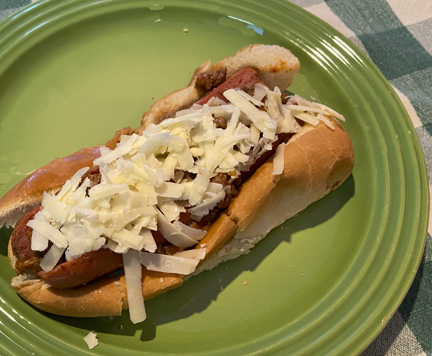
To make them more interesting (and to create an actual recipe to share with readers), I have decided to make chili dogs. Like the film, this dish is quite messy but ultimately satisfying.

Everything Everywhere Chili Dogs

I usually make chili with lots of beans, but when I was in graduate school my friend Shannon informed me that the protein in chili-dog chili should always be beef and only beef. So that is what I use here.

Ingredients:

for the chili:
1 splash olive oil
1 medium onion, finely chopped
1 large clove garlic, minced
1 pound lean ground beef
1 tablespoon chili powder
1 teaspoon ground cumin
1/2 teaspoon chipotle powder (if you don’t have chipotle, use another dried pepper, but I love the slight smokiness of the chipotle)
3/4 teaspoon salt
ground pepper to taste
1 can (14.5 ounces) crushed tomatoes
1 cup water

for the chili dogs:
6 hot dogs (I prefer all beef)
6 hot dog rolls
the chili
grated sharp cheddar cheese to taste

Instructions:

Begin by making the chili. Heat the oil in a skillet. Add the onion, and sauté for a few minutes until it smells lovely and starts to brown. Add the garlic and sauté again briefly.

Add the beef, breaking it up into small pieces as you stir and brown it. When the beef has browned, stir in the spices, the salt, and the pepper, followed by the tomatoes and the water.

Bring the mixture to a boil; then turn it down and simmer it for 30 to 40 minutes, until the flavors blend and the liquid has mostly, but not completely, boiled off. Taste and adjust the seasonings.

Cook the hot dogs in your preferred method, boiling or grilling. While the hot dogs are heating up, lightly toast the hot-dog rolls.

Onto each roll place a hot dog. Partially slicing the dogs lengthwise makes it easier to add toppings: a generous helping of chili and some of the cheese. Serves 6 Academy-Award guests. This recipe may be multiplied.

Photo Credit: Allyson Riggs

Easy Comfort Food

Saturday, November 23rd, 2019


As we start planning and cooking for Thanksgiving, I’m serving my family simple dishes that don’t take a lot of work. I figure we’ll have plenty of work in the kitchen this coming Thursday.

As you embark on the preparations and cooking for Thanksgiving, it’s wise to keep some meals simple and effortless for your family. After all, the big day itself will require plenty of time and effort in the kitchen. Why not treat your loved ones to some mouthwatering American food recipes that offer both simplicity and satisfaction? Consider indulging in Thanksgiving hamburgers or savoring a succulent steak. For more delectable American recipes that will elevate your Thanksgiving feast, visit the https://thisamericanplate.com/. Discover a treasure trove of culinary inspiration to make this Thanksgiving a truly memorable one. These dishes can be a delightful departure from traditional Thanksgiving fare, offering a unique twist to your holiday menu. 

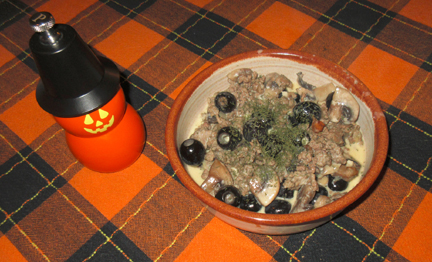
This dish, featured in my Pudding Hollow Cookbook, is one of my mother’s standbys when she wanted an easy, warming meal. Make it with the best ingredients you can, and enjoy the way the dill and the sour cream go together with the meat and vegetables.

I made it recently on Mass Appeal, and it was a big hit.

Happy Thanksgiving! I wish you joy … and delicious dishes along with your turkey like cranberry chutney, biscuits, Brussels sprouts salad, and harvest salad.

Hamburger Stroganoff

Ingredients:

1 cup minced onion
1 clove minced garlic
a dab of sweet butter
1 pound ground beef
1/4 pound mushrooms, sautéed in sweet butter (or a lot more!)
1 can (6 ounces) ripe olives
a generous splash of chicken broth or stock
salt and pepper to taste
1 cup sour cream, plus a little more if needed
a sprinkle of fresh or dried dill

Instructions:

Sauté the onion and garlic in the butter. Stir in the beef and brown it. Drain off the fat if it looks excessive. Add the mushrooms, olives, and stock (the latter should pretty much cover the mixture), plus the salt and pepper.

Partially cover and cook for 20 minutes to half an hour, until the liquid has almost evaporated. Stir in the sour cream and heat but do not boil. Sprinkle dill over the Stroganoff and serve over rice or noodles. Serves 4.


Rhubarb-Glazed Meatballs

Friday, June 8th, 2018

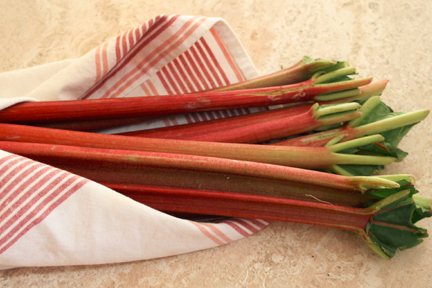
I hope you’re not tiring of rhubarb! I’m still surrounded by it, going from event to event selling my cookbook, Love, Laughter, and Rhubarb.

I’m having fun trying to convert the entire world to the love of rhubarb.

If you’re in New England, please join me at one (or more) of my upcoming events. This evening, Friday, June 8, at 6:30 p.m. I’ll be talking about the book at the Arms Library in Shelburne Falls. Boswell’s Books will be on hand to sell copies of the book, and nibbles will OF COURSE be served.

On Saturday, June 9, from 10 to 3, I’ll have a table at the Lenox Rhubarb Festival in Lenox, Massachusetts. I’ll sign books, of course, and serve samples (until the samples run out; I gather the festival attracts quite a crowd).

On Saturday, June 16, from noon to 5, I’ll be signing books in Sherman, Connecticut, at the White Silo Farm and Winery Rhubarb Festival. I don’t have to bring food to this event because the chef at White Silo is making a number of tasty rhubarb dishes, including my own rhubarb pizza! If you’d like to learn more about my upcoming events (yes, there will be quite a few), visit my website.

The recipe below, which I made on Mass Appeal this week, won’t be coming with me to any events; it’s wet and warm and therefore not ideal to transport. Do try it, however, especially if you like sweet/sour combinations. I have served it as a main course, but it also makes an excellent appetizer.

If you have my book, please let me know what you’re cooking from it. And if you don’t have it, here’s a great place to find it!

I’m having trouble embedding videos these days, but you may watch my TV appearance by clicking on this link. The second dish we made, “Bee Mine Rhubarb Crumble,” substituted honey for the white sugar in my standard rhubarb crumble recipe as noted last year. (Note: I would cut down on the honey in this recipe; that stuff is sweet!)

The honey pays tribute to yet ANOTHER festival this week, the Langstroth Bee Festival in Greenfield. I wish it weren’t on the same day as the rhubarb festival! But I can always bee there next year.

Happy spring!

Rhubarb Glazed Meatballs

Ingredients:

for the stewed rhubarb:

2 pounds rhubarb (about 6 cups chopped)
2/3 to 1 cup sugar
2 teaspoons lemon juice
1 teaspoon cinnamon (optional)

for the meatballs:

1 pound lean ground beef
1/3 cup finely chopped onion
1 garlic clove, finely minced
1/3 cup dried breadcrumbs
1/2 teaspoon salt
1/8 teaspoon black pepper
2 eggs, slightly beaten
1 12-ounce bottle chili sauce
2-1/2 to 2-3/4 cups stewed rhubarb (you will have some extra from the recipe above, which I encourage you to eat as it is!), pureed in a blender

Instructions:

First, stew your rhubarb. Wash and trim the rhubarb. Cut it into 1-inch pieces. In a heavy, nonreactive saucepan, combine all the ingredients and cover. Let the pan sit for an hour or so to allow the rhubarb to juice up; then cook it over low heat until the rhubarb softens (at least 5 to 7 minutes; maybe more depending on your stove).

Preheat the oven to 375 degrees. In a large bowl combine all the ingredients except the chili sauce and rhubarb.

Mix well; then shape the mixture into 1-inch balls. Place the balls on a large rimmed baking sheet (I like to line it with nonstick aluminum foil), and bake the meatballs for 25 to 30 minutes (or until done).

While the meatballs are baking, combine the chili sauce and rhubarb in a 3-quart saucepan. Bring them to a simmer and cook for 5 minutes, stirring frequently.

When the meatballs are done add them to the sauce. Stir to coat, and simmer for 5 more minutes, stirring gently from time to time.

Makes 24 to 30 meatballs.

Before I leave you, here’s a link to another of my appearances, a humorous segment from our local public radio station. The interview was fun, and the video is priceless—not because I sing or play the piano particularly well (it wasn’t a great day for either skill!) but because you can hear my irrepressible dog, Cocoa, sing along with me. Here is the link!