Posts Tagged ‘Cookbooks’

Breads Galore

Tuesday, January 14th, 2025

Bread is one of humanity’s earliest foods. It is certainly the oldest food that uses cultivated crops. It is meaningful to us humans in many ways. It symbolizes warmth, nourishment, and home.

Just as everyone in my family grew up using The Fannie Farmer Cookbook, every one among us (well, every woman among us) grew up baking bread with King Arthur Flour.

From a company that could trace its roots back to 1790 (King Arthur calls it “the first flour company in the young United States”), this unbleached flour was named King Arthur in the late 19th century.

The name combined romance and practicality, as does the creation of bread itself. Baking bread is a way of feeding one’s family. It is also a way of showing love.

The King Arthur Flour company re-christened itself King Arthur Baking in 2020 to reflect the growing diversity of its offerings—not just many types of flour and other ingredients, but also recipes, equipment, and even classes.

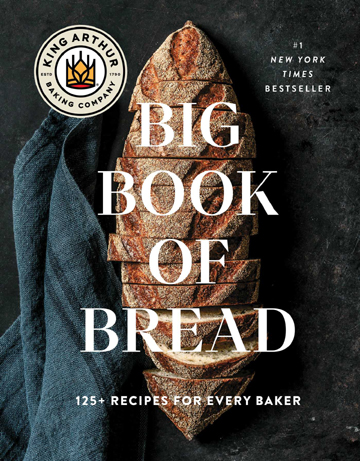
Despite all this history, the company came out with a bread-baking book only this past October. The King Arthur Baking Company Big Book of Bread (Simon Element, 464 pages, $45) was the brainchild of my part-time neighbor in Hawley, Doris Cooper, who is an editor at the book’s publisher.

Doris spent summers here as a child, and she visits her family in Pudding Hollow frequently. I was tickled when I read the book to see her listed as editor. I asked her how the project came about.

“I really wanted to do a book with them,” Doris told me, meaning the King Arthur Company. “So I pursued them for years.”

It helped that the drive to King Arthur is less than two hours from Hawley. “It was a very appealing aspect of this project that I could go there,” she laughed, noting that the bakers at King Arthur are “definitely Franklin County kindred folk.”

Cookbooks are among Doris’s specialties as an editor. She grew up in a family of cooks (I can testify to the culinary skill of both her parents) and loves “finding new and surprising ways to combine ingredients.”

She also enjoys cookbooks because unlike novels, for example, they don’t have to be read from start to finish. “I like doing books that you can find your way into,” she elaborated.

In fact, I would suggest that readers not try to read the “Big Book of Bread” from start to finish. They may find themselves exhausted … and not a little daunted.

The book’s opening chapter presents the tools and techniques the authors (all of whom work at King Arthur) recommend. The lists are long.

I bake bread as much as—probably more than—the next person. I don’t have all the tools the authors think I should. I will probably add tools as time goes by based on the book’s suggestions, but I don’t need to possess all the recommended gadgets to enjoy using the recipes and tips in the book.

I recommend that readers skim that first chapter, and return to it later as needed, before diving into the more than 125 recipes in the book. The array includes flat breads, yeast breads, sourdough breads, rolls, and even dishes that include prepared bread.

Doris told me she likes the way the book caters to the way people cook (and eat) today. I see her point. Many of the recipes come from other parts of the globe. Most look extremely doable.

Each recipe is accompanied by a gorgeous photograph to show the baker what s/he is getting into. And the book has the best explanation of the process of creating a sourdough starter I have ever seen.

For those readers not quite ready to venture into sourdough territory, it also includes several recipes that compromise between yeast and sourdough bread by using a preferment. A preferment is a bit of bread dough mixed well in advance of the main recipe that can add flavor and texture to the final product.

With all these features, it’s no wonder that The King Arthur Big Book of Bread jumped to the top of The New York Times best-seller list right after it came out. Doris says she is gratified that it did so. It wasn’t the aim when she and the authors put the book together, however.

“Our goal was that it would become the go-to bread book for the next decade,” she told me.

In my house, it will probably be that book much longer. The current edition of Fannie Farmer came out in 1996, and no one is going to be able to pry that out of my hands anytime soon. I imagine the Big Book of Bread will achieve similar longevity on my cookbook shelf.

 (Not So) Basic White Sandwich Bread

I chose this bread to feature from the book because it’s relatively simple, and of course delicious. The authors estimate that making it will take approximately 5 hours, although much of that time doesn’t require any work on the baker’s part! They note, “The dough is slightly sticky but can be mixed by hand or in a stand mixer.”

Excerpted from THE KING ARTHUR BAKING COMPANY BIG BOOK OF BREAD: 125+ Recipes for Every Baker. Copyright ©2024 by Jessica Battilana, Martin Philip, and Melanie Wanders. Photography Copyright ©2024 by Ed Anderson. Reproduced by permission of Simon Element, an imprint of Simon & Schuster. All rights reserved.

 Ingredients:

360 grams (3 cups) unbleached all-purpose flour, plus more for dusting
25 grams (2 tablespoons) sugar
7.5 grams (1-1/4 teaspoons) fine salt
6 grams (2 teaspoons) instant yeast
57 grams (4 tablespoons) unsalted butter, melted
142 grams (1/2 cup plus 2 tablespoons) warm milk, whole preferred
127 grams (1/2 cup plus 1 tablespoon) warm water

Instructions:

To make the dough: In a medium bowl, combine the flour, sugar, salt, yeast, butter, milk, and water. Mix with the handle of a wooden spoon until no dry patches of flour remain and a soft, sticky dough forms. Cover and let rest for 15 minutes.

Transfer the dough to a lightly floured surface and knead until a tacky, springy dough forms, about 5 minutes.

The dough will be sticky at first but will smooth out quickly; to make it easier to handle, use a bench knife to scrape the dough off your work surface as you knead, which will speed up the process and reduce the amount of flour required for kneading. (Adding too much flour at this stage can make your bread denser.)

Return the dough to the bowl, cover, and let rise at room temperature until puffy though not necessarily doubled in size, 1 to 2 hours.

Alternatively, in a stand mixer fitted with the dough-hook attachment, mix the dough on medium-low speed until no dry patches of flour remain. Increase speed to medium and mix until smooth, elastic, and pulling away from the sides of the bowl, about 5 minutes.

Cover and let rise at room temperature until puffy though not necessarily doubled in bulk, 1 to 2 hours.

Grease an 8-by-4-1/2-inch loaf pan with pan spray.

Shape the dough and let it rise: Lightly flour a work surface; then use a plastic bowl scraper to ease the dough out of the bowl onto the work surface. Gently deflate the dough and pat it into a 12-by-8-inch rectangle. Shape the dough into a log by bringing the short sides toward the center, overlapping them slightly.

Flatten the dough into an even layer; then starting from the top, gently roll the dough toward you to form a log and pinch the seam to seal; then place it seam-side down in the prepared pan. Cover and let rise at room temperature until the loaf crowns about 1 inch over the edge of the pan, 1-1/2 to 2 hours.

Toward the end of the rising time, preheat the oven to 350 degrees.

To bake: Bake the bread until the crust is golden brown and the internal temperature reaches 190 degrees, 30 to 35 minutes.

Remove the loaf from the oven and immediately turn it out of the pan and onto a rack. Doing this right away helps the bread come out of the pan easily and preserves the crust. Let cool completely before slicing. Makes 1 loaf.


Soup Nights (and Days!)

Monday, January 16th, 2017

Betty Rosbottom spent her formative years in areas known for their food. In her childhood home of Memphis, Tenn., she enjoyed that city’s signature barbecue. She attended college in New Orleans, where she learned to love Cajun and Creole dishes. She spent her junior year at the Sorbonne savoring French cuisine.

Nevertheless, she spent no time in the kitchen herself until she married. “I couldn’t cook a thing during any of my upbringing,” Betty told me in a recent telephone interview. “I was just an appreciator.”

Her husband gave her a copy of Julia Child’s Mastering the Art of French Cooking as a wedding present. “It was my first learning experience about food,” recalled Betty. “I was so naïve I thought ALL recipes were five pages long.”

Once she started cooking, she never stopped. She founded a cooking school in Columbus, Ohio, in the late 1970s and learned from guest teachers like gourmet legend Jacques Pepin and “queen of cake” Maida Heatter. Eventually, she attended the Parisian cooking school La Varenne.

Betty has written a syndicated food column, hosted a PBS food show, taught cooking in many venues, and written 11 cookbooks. The most recent of those books is Soup Nights, published just in time for National Soup Month (January) by Rizzoli.

I asked Betty about her earliest happy recollection of soup. Ironically, she told me, her first beloved soup—French Onion Soup Gratiné—graces the front cover of “Soup Nights.” She fell in love with this classic French favorite at les Halles, Paris’s big central market, during her junior year abroad. Les Halles has since closed; I am lucky enough to have visited the market and tasted that ambrosial soup as a small child.

Betty loves soup in general as well as in particular, however. “For me [soup is] just a sense of well being,” she explained. “Every culture has soups. They’re comforting. They can be hot. They can be cold. In the winter they warm you up, and in the summer they cool you down.”

They can also be very forgiving,” she added, noting that a thin soup can be thickened or a thick one thinned. “If you put a little too much salt in a soup, you can put in a raw potato.”

Soups are handy for anyone looking for a simple, inexpensive way to entertain, she noted. “Not only can you make soup in advance and it’s helpful for you as a host or a hostess, but it improves with time.”

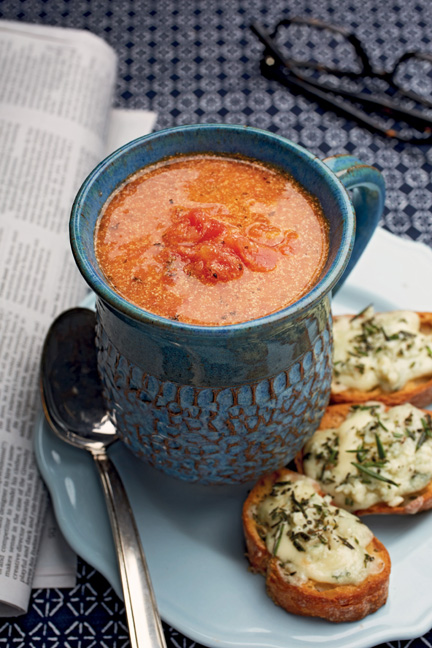
I asked Betty to walk me through the process of creating one of the recipes in Soup Nights. She explained the thinking behind her Winter Tomato & Garlic Soup, which uses ingredients she tends to have in her cupboard—canned tomatoes, chicken stock, onion, garlic.

“I love tomato soup,” she enthused. “As a child I the only tomato soup I ever had was the one that came in the red-and-white Campbell’s can. It was a revelation to me that you can make tomato soup.

“I always like to give a kind of citrus taste to tomato soup. This one has orange zest. It lightens the soup a little bit.”

Eager to help readers figure out what to serve with their soup (her book features sandwiches, salads, and desserts as well as straight soups), Betty Rosbottom suggests pairing the tomato soup with Gorgonzola bruschette.

“When we have a nor’easter coming, this soup will serve a lot … and it gets better when you make it ahead of time.”

Betty Rosbottom wasn’t at liberty to tell me what her next project will be, but she predicted that it will be “very popular.” She lives in Amherst, Massachusetts, but she is spending January in her favorite city in the world, Paris, doing culinary research.

In fact, when we spoke she was in her Paris apartment. The long distance connection made me happy if just a little jealous. During our conversation I could almost smell the onion soup!

Courtesy of Betty Rosbottom

“Midnight in Paris” Onion Soup Gratiné

© Soup Nights by Betty Rosbottom, Rizzoli New York, 2016. Used with permission.

Ingredients:

for the soup:

2 quarts beef stock
4 tablespoons unsalted butter
2 tablespoons vegetable oil
3 pounds yellow onions, sliced 1/4-inch thick, to yield 10 cups
kosher salt
1/4 teaspoon sugar, plus more if needed
1/4 cup all-purpose flour
3/4 cup dry white wine
freshly ground black pepper

for the croutons:

18 baguette slices, cut about 3/8-inch thick
3 to 4 tablespoons olive oil, plus more if needed
1 12-ounce piece good quality aged Gruyère grated to yield 1-1/2 cups and the remainder cut into slivers (1/4-inch by 1-inch long) to yield 1/2 cup

Instructions:

Set the stock in a pot over very low heat; then cover it. Keep the stock warm at a very low simmer while you prepare the soup.

In a 5-quart heavy pot (with a lid) over medium-low heat, heat the butter and oil. When hot, add the onions. Cover and cook, stirring frequently, 15 minutes.

Remove the lid, and raise the heat to medium. Stir in 1 teaspoon salt, the sugar, and the flour. Cook, stirring constantly, scraping the bottom of the pan so that the flour does not burn, until the onions are rich golden (like the color of light brown sugar), 35 to 40 minutes or more.

(While you are cooking the onions, the flour will start to darken too and the onions will cook down considerably. That’s okay.)

When the onions are done, add the simmering stock and 1/2 cup of the wine. Season the soup with salt and pepper, and a pinch or two of extra sugar if desired. Simmer, partially covered with the lid set ajar, 40 minutes more.

With a large spoon, skim off any foam that forms. Add the remaining 1/4 cup wine and season the soup again with salt and pepper. (Soup can be prepared three days ahead. Cook to this stage, then cool, cover, and refrigerate. Reheat over medium heat.)

While the soup is simmering, prepare the baguette slices and the cheese topping. Arrange a rack at center position of the oven and preheat to 350 degrees.

Brush the baguette slices generously on both sides with olive oil and arrange on a rimmed baking sheet.

Bake until the slices are crisp, 4 to 5 minutes per side. Remove and cool. (The baguette slices can be prepared two days ahead; store in an airtight container at room temperature.) Retain oven temperature.

Arrange 6 ovenproof soup bowls or ramekins on a rimmed baking sheet and fill them 3/4 full with the hot soup.

Divide the slivered cheese among the bowls. Float 2 to 3 baguette slices on top of each serving, and sprinkle generously with some grated cheese. Depending on the size of your bowls or ramekins, you may have some soup, cheese, or croutons left over.

Bake the soups until the cheese has melted and is lightly browned, 15 minutes. Watch constantly. If desired, run under a hot broiler to brown more, 1 to 2 minutes. Serves 6.

Winter Tomato & Garlic Soup with Creamy Gorgonzola Bruschette

© Soup Nights by Betty Rosbottom, Rizzoli New York, 2016. Used with permission.

Ingredients:

3 tablespoons olive oil
1-1/2 cups chopped onion
2 tablespoons minced garlic
2 28-ounce cans diced tomatoes, drained well
3-1/2 cups chicken broth or stock, plus more if needed
1 tablespoon dried basil
a scant 1/2 teaspoon red pepper flakes, plus more if needed
kosher salt

a scant 1/2 TSP red pepper flakes, plus more if needed
kosher salt
2 small pinches sugar
3/4 cup half-and-half
1/4 cup grated Parmesan cheese, preferably Parmigiano Reggiano
1 tablespoon grated orange zest

Instructions:

In a heavy, 4-quart saucepan over medium heat, heat the oil until hot. Add the onions and stir until they start to soften, 3 to 4 minutes. Add the garlic and stir for 1 minute more. Add tomatoes, 3-1/2 cups broth, basil, red pepper flakes, 1/4 teaspoon salt, and sugar. Stir well to combine and bring mixture to a simmer. Reduce heat to low and continue to simmer until vegetables are tender, about 20 minutes.

Purée the soup in batches in a food processor, blender, or food mill, then return the soup to the pot. (Or use an immersion blender to purée the soup in the pot.) The mixture will be somewhat chunky. Stir in the half-and-half, Parmesan cheese, and orange zest and cook over medium heat, stirring, until the soup is heated through, 3 to 4 minutes. If the soup is too thick, thin it with 1/2 cup extra broth. Season the soup with salt if needed and, if you’d like more heat, add a pinch of red pepper flakes. (Soup can be prepared two days ahead. Cook to this stage, then cool, cover, and refrigerate. Reheat, stirring often, over medium heat.)

Ladle the soup into bowls. Serve with the Gorgonzola Bruschette alongside or, if you prefer, float one on top of each serving. Serves 6.

Gorgonzola-Rosemary Bruschette

Ingredients:

12 baguette slices, cut 3/8-inch thick
olive oil for brushing
1 8-ounce piece creamy Gorgonzola, such as Gorgonzola Dolce, softened slightly
1 tablespoon chopped fresh rosemary

Instructions:

Arrange a rack at center position and preheat the oven to 350°F. Have a foil-lined baking sheet ready.

Brush both sides of the baguette slices generously with olive oil and place on the baking sheet. Bake slices until golden and just crisp, 3 to 4 minutes per side. (Slices can be prepared 2 hours ahead. Keep at room temperature.)

Spread each slice with Gorgonzola; then return to the oven until cheese has melted, 3 to 4 minutes. Sprinkle each slice with chopped rosemary.

© Harry Zernike. Used with permission.