On New Year’s Eve and New Year’s Day, we celebrate both the old and the new. We are looking—like the Roman god Janus, for whom January was named—in two directions. To me, this means that the transition to a new year often involves making new-to-me recipes that are nonetheless traditional.
For my New Year’s gathering, I’m making a cheese ball recipe given to me by Sarah Riley of Greenfield, Massachusetts. I had never made a cheese ball before trying this one. For Sarah, it is a tradition started by her mother. To her family it represents home and holidays literally wrapped up in a ball.
Cheese balls were a beloved American appetizer from the late 19th century into the mid-20th century. They combine convenience and creativity; they are shaped using pre-constituted ingredients, but those ingredients vary according to the cook.
By the 1980s, they began to fade from popularity. Amanda Hesser of The New York Times eventually wrote that the balls “tend to be associated with shag rugs and tinsel, symbols of the middle-class middlebrow.”
I guess I’m a middle-class middlebrow.
Fortunately for my self-respect, cheese balls have re-emerged to some extent. Even Hesser accepted them … if they were homemade.
Satirists Amy and David Sedaris centered their 2001 play The Book of Liz around a cheese-ball maker. And in 2012, Michelle Buffardi published the popular book Great Balls of Cheese.
The Food Timeline conducted a survey of cheese balls in cookbooks. “Much to our surprise,” reported the editors, “cheese balls can be deep fried, baked, or refrigerated. They can be served hot or cold. They can accompany salads, be served as appetizers or pop up as desserts.”
The first recorded American cheese ball dates to 1801 and came from the town of Cheshire, not far from me in Western Massachusetts. Cheshire was founded by Baptists, many of whom were dairy farmers.
Elder John Leland was elated when Thomas Jefferson was elected president. Like many in our area of the state, Leland supported the Jeffersonian concept of the yeoman farmer as the ideal citizen of the newly formed United States.
Leland had become acquainted with Jefferson earlier while living in Virginia and had campaigned for the new president. He and his fellow Baptists, a definite minority in mostly Congregational Massachusetts at the time, were grateful for Jefferson’s espousal of religious liberty for all Americans.
Leland dreamed of devising a fitting tribute to President Jefferson. He asked all the farmers in Cheshire to contribute the curds from one day’s milking to the creation of a giant cheese ball, which came to be known as the Mammoth Cheese.
(It wasn’t actually a cheese ball, just an enormous chunk of cheese, but it is commonly referred to as a cheese ball so I’m alluding to it as such.)
A concrete recreation of the large press that created the Mammoth Cheese may be viewed in Cheshire. The town also houses a life-size replica of the actual cheese, created by Adams sculptor Brent Whitney.

Courtesy of “Listening to America”
The Mammoth Cheese was the product of about 900 cows. It weighed 1235 pounds.
It wasn’t easy to transport the cheese to the White House, but John Leland managed to do it.
In Mississippi Sideboard, Jesse Yancy wrote, “Preaching all the way to Washington (some things never change), [Leland] transported the ball by wagon and then rolled it across the White House lawn to serve it to President Jefferson.”
According to the National Portrait Gallery’s website, “The Mammoth Cheese was so awe-inspiring, that it marks the first use of the word ‘mammoth’ as an adjective spurred by a nationwide fascination with mammoths following the discovery of large prehistoric bones in the new world.”
John Leland presented his Mammoth Cheese to Jefferson on January 1, 1802. A fervent Abolitionist, Leland proudly proclaimed to the president that the cheese had been fashioned without the help of slave labor.
The cheese became an instant media sensation. Poet Thomas Kennedy even composed an “Ode to the Mammoth Cheese.” One stanza read:
God bless the cheese—and kindly bless the makers,
The givers—generous—good and sweet and fair,
And the receiver—great beyond compare,
All those who shall be happy as partakers;
O! May no traitor to his country’s cause
E’er have a bit of thee between his jaws.
How was the cheese consumed? In Culture, Dakota Mackey wrote, “Though stories vary about what happened to the cheese, the most popular tale is that it was displayed at the White House for two years and served at various Republican party functions before being tossed into the Potomac River.”
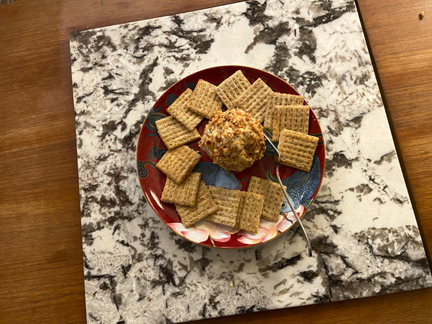
Luckily for the nearest body of water to me, Hawley’s Mill Brook, the balls I made using Sarah Riley’s recipe were small and tasty enough to be devoured by my family and guests before any tossing was called for.
To make sure we could eat our cheese quickly, I prepared a half recipe. It made two small balls. I love cheese, but I feel for the residents of Thomas Jefferson’s White House as they lived with the smell of the Mammoth Cheese for two years.
Here is Sarah’s more modest recipe. Consider serving it to ring in the new year. I wish you good health, peace, and lots of yummy food in 2025.
Sarah Riley’s Not-So-Mammoth Cheese Ball
Ingredients:
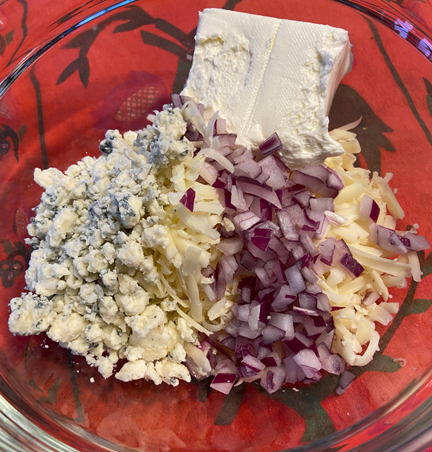
8 to 12 ounces Cabot sharp Cheddar cheese
8 ounces (1 brick) cream cheese, at room temperature
4 ounces blue cheese (more or less to taste; I used a little more)
1/3 cup finely chopped red onion.
Blue Diamond smoked almonds, finely chopped
(Start with 3 ounces, and then chop more if needed.)
Instructions:
Grate the cheddar into a bowl. Add the cream cheese, the blue cheese, and the red onion pieces. Sarah recommends mixing these ingredients together with one’ s hands. She says sometimes she wears gloves. I didn’t use gloves but made sure that my hands were immaculately clean.
Shape the mixture into 2 to 4 balls. Roll the balls in the chopped almonds.
Cover the balls and refrigerate them for a couple of hours. Makes 2 large (but not mammoth) or 4 small balls.