Posts Tagged ‘Jan Hallett Weisblat’

Soup Month: French Onion Soup

Monday, January 26th, 2026

January is National Soup Month. This January has been a doozy weatherwise, and I have indulged in a lot of warm soup.

One of my favorite soups at this time of year (or any time of year, really, but it is hardy so January is ideal for it) is my mother’s French Onion Soup. She of course preferred to call it “Soupe a l’Oignon,” Francophile that she was.

I’m not precisely sure when Taffy, as I called her, learned to make this soup. She had two French cooking teachers. The first was Madame Continénie, her landlady in Paris during her Junior Year Abroad in Paris in the late 1930s.

Madame taught my mother how to make many basic dishes. She also tried to make her teenage guest more sophisticated. The first endeavor was more successful than the second. My mother had many wonderful qualities, but sophistication was not one of them. Luckily, she didn’t need to be sophisticated or soignée. She was direct, fun, and smart. Those qualities stood her in good stead throughout her life.

Taffy went on to study French cooking at a Cordon Bleu school in New York in the late 1950s or early 1960s. Her teacher there, Madame Béran, taught her a lot about cooking and also about French.

In Taffy’s little handwritten cookbook, she sometimes inscribed recipes in French even when she had clearly learned them from Americans. She adored the French language.

Whoever taught her to make it, this soup was a staple of my youth. It uses one of my favorite techniques, caramelizing onions. Gently frying onions for a long time always makes the house smell homey and delicious.

Taffy’s recipe gets additional robust flavor by using beef broth and red wine instead of the chicken broth and white wine that are more usual in this country.

Please do not misunderstand me. I will happily slurp down onion soup however it is made. I do think that the darker, more flavorful broth and wine make it even tastier, however.

Whenever my mother went to Paris, she made a point of visiting Les Halles, the popular open-air market that was founded in the 12th century. The market was known for its Soupe a l’Oignon. One could find this soup there at any hour of the day or night, and it was always freshly made and fabulous.

Les Halles around the Turn of the Last Century’ (Library of Congress)

My parents took me to Les Halles first when I was seven and had never tasted onion soup. Like my mother, I fell instantly in love with the soup and with the bustling market in which it was served … although I was small enough to need help getting up onto a chair there to eat.

Taffy was saddened when the market was torn down in 1973 to make room for an underground shopping center that had none of the original’s character and charm. The area is now a mall. Luckily, Taffy, who emphatically did not believe that her beloved Paris needed a mall, never learned of that final transformation.

The old Les Halles market lived on in her kitchen and continues to do so in mine … in January or in any other month. As Marcel Proust noted when he wrote of madeleines, flavor is an ideal vehicle for transporting us into the past.

This particular flavor made me VERY happy earlier this month when the weather was disgusting.

If you’re in a hurry or don’t have oven-proof bowls or crocks, don’t worry about putting the cheese on toasted bread and broiling it. Just serve the soup with grated cheese on top and toasted bread on the side.

Serving the soup with the broiled bread and cheese (“gratinée”) is more authentically Parisian, however. And quite delicious.

I probably have no need to tell you that my mother had oven-proof crocks, which she bequeathed to me. In fact, she had, and I have, TWO sets of crocks. The one I prefer has little baskets to hold the hot soup when it comes out of the oven.

Taffy’s French Onion Soup

Ingredients:

for the soup:
4 tablespoons (1/2 stick) sweet butter
2 tablespoons extra-virgin olive oil
6 medium onions, finely sliced
1 teaspoon Dijon mustard
salt and pepper to taste (Start with 1/2 teaspoon salt and 8 turns of your pepper grinder.)
1 generous teaspoon flour
4-1/2 cups beef broth
1/2 cup red wine (a little more is fine!)

for the topping:
sliced baguette (enough to cover the soup in the 4 crocks; it doesn’t hurt to have extra, however; the toasted slices make great crackers for dip or cheese)
a drizzle or two of extra-virgin olive oil
grated or sliced Gruyère or other Swiss-type cheese as needed (Last week I ended up using “Swiss” slices from the grocery store, which were inelegant but sufficient; I used 2 slices per crock.)

Instructions:

Melt the butter in a Dutch oven. (I used my 5-1/2-quart pot. The freshly sliced onions take up a fair amount of room, although they do shrink as they cook.)

Add the oil and the onions. Cook fiercely over medium-high heat for a few minutes; then turn down the heat and continue cooking, stirring every 5 to 10 minutes, until the onions begin to turn golden. This will take from 1/2 hour to 1 hour. While the onions are caramelizing toast the bread. (See below.)

Stir in the mustard, the salt, the pepper, and the flour. Stir for 1 minute or until the mixture is smooth. Slowly add the broth and the wine.

Bring the soup to a boil, turn it down, cover it, and simmer it for 15 to 20 minutes. After the 15 minutes, taste it and see whether it needs a little more salt. (You shouldn’t need a lot; the cheese is salty!)

You will know that the soup is ready when it tastes warm and flavorful. The taste of the wine should be perceivable but not strong.

To toast the bread slices, preheat the oven to 350 degrees. Lightly rub the pieces of baguette on both sides with a little olive oil, or spray them with an olive-oil spray. This is a balancing act. The oil helps the bread toast and adds flavor. You don’t want the pieces of bread to taste oily, however.

Place the bread pieces on a rimmed cookie sheet and bake them for 20 minutes, turning once. Set them aside to wait for the soup.

When the soup is almost ready, preheat the broiler. Ladle the soup into 4 ovenproof crocks, place toasted bread on top of each crock (you will need 1 to 3 slices, depending on the size of your baguette), and cover with cheese.

Broil the soup on high until the cheese melts and turns golden brown. Serve within a few minutes, but warn your fellow sippers to be careful. Onion soup can get very hot and burn the tongue. Serves 4.

Taffy with a Friend
Centennial Songs and Recipes

Wednesday, August 15th, 2018

Like most human beings, I like thinking about summer when snow is on the ground outside. So I started contemplating my summer concert this past January when the air was crisp and cold.

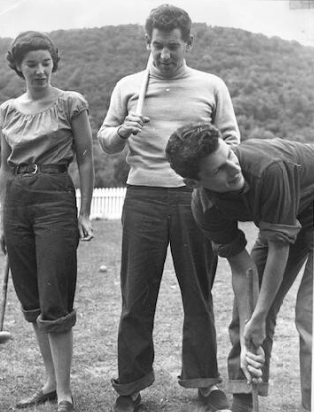
I knew that Leonard Bernstein had been born in 1918 and that I wanted to salute him in the concert, particularly because I knew that he had spent some time (well, one summer) down the road from my house, at Singing Brook Farm here in Hawley, Massachusetts.

Leonard Bernstein (center) at Singing Brook Farm in 1949 with his Sister and Brother

I also knew that my voice (which is just fine but not exceptional) wasn’t up for an all-Bernstein concert. It occurred to me that the concert might be expanded to cover a range of musical figures born in 1918.

I did a little research, and it turned out that quite a few American composers and singers came into the world that year: lyricist Alan Jay Lerner, of Lerner and Loewe; Patty Andrews, of the Andrews Sisters; singer/actress Pearl Bailey; crooner/actor Robert Preston, best known as the loveable con artist in The Music Man; and many more.

I wasn’t 100 percent I wanted to make 1918 the focus of my concert until I recalled that my late mother, Janice Hallett Weisblat, was also a 1918 baby.

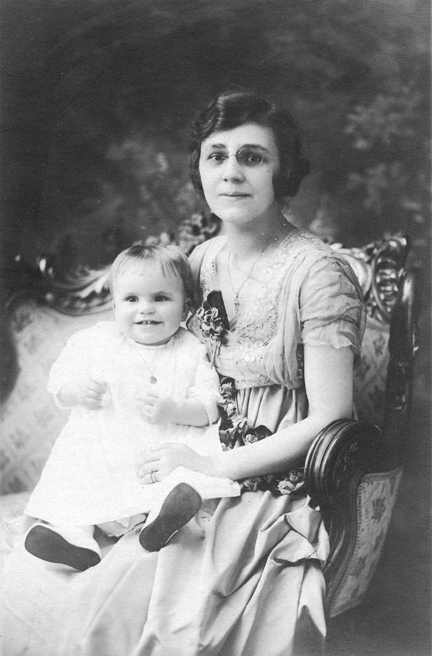
Baby Janice with her Mother, Clara

Jan, whom I called Taffy, didn’t have a professional-quality voice. In fact, she lost much of her vocal range singing too hard while suffering from a cold one evening when I was a small child. Nevertheless, she adored music and used the range she had left to sing her heart out whenever possible. Singing a couple of her favorite songs seemed like a wonderful way to celebrate her centennial year.

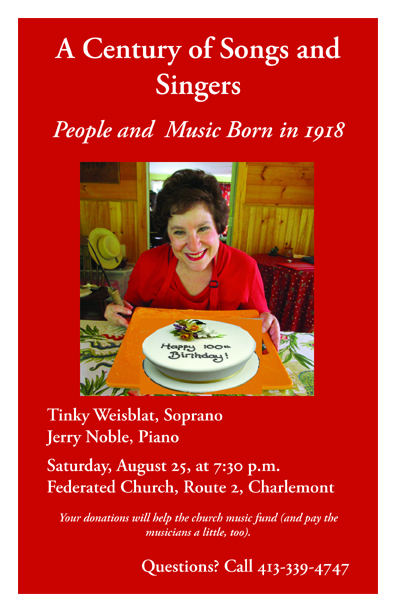
My concert, called “A Century of Songs and Singers,” will take place next Saturday, August 25 (Bernstein’s birthday), at the Federated Church on Main Street (Route 2) in Charlemont, Massachusetts. I will be accompanied by Jerry Noble, a delightful person and musician.

Please join us if you’re in the neighborhood. If you can’t come to the concert, you might like to make a dish or two from 1918 babies, as I did this week on Mass Appeal. I made Pearl Bailey’s Corn Fritters and my mother’s Blueberry Sally Lunn.

The blueberry recipe appears elsewhere on this blog as Blueberry Snap. I share the corn recipe below, along with the videos in which I make the dishes.

Pearl Bailey

Pearlie Mae’s Corn Fritters

Pearl Bailey’s “cookbook,” Pearl’s Kitchen, is pretty vague about the proportions in this recipe so I had to more or less construct them myself. I recommend her book and her music nevertheless. Pearl’s Kitchen shows off its author’s remarkable spirit. She writes:

To cook is to share, and it is as important to me as walking onto the stage to full applause. Cooking is as crucial as anything I do in life, because I like to see the smiles on people’s faces when they enjoy something I have prepared. I cook as I live.

Amen.

Ingredients:

1 cup flour
1-1/2 teaspoons sugar
1/2 teaspoon baking powder
salt and pepper to taste
1 cup milk
1 egg
2 cups lightly cooked corn kernels
butter as needed for frying

Instructions:

In a bowl combine the flour, the sugar, the baking powder, the salt, and the pepper. Make a well in the center of this mixture.

In another bowl or a measuring cup whisk together the milk and egg. Pour them into the dry ingredients, and mix. Stir in the corn kernels.

Put a pat of butter in a frying pan over medium-low heat. The butter should melt and begin to bubble but not burn. Pop in small scoops of the corn batter.

Fry on both sides. “Just let it bubble away until it browns, then turn it over,” said Pearl Bailey. Serves a crowd.

And now the videos:

Pearly Mae’s Corn Fritters

Taffy’s Blueberry Sally Lunn

We’ll Always Have Paris

Friday, May 11th, 2018

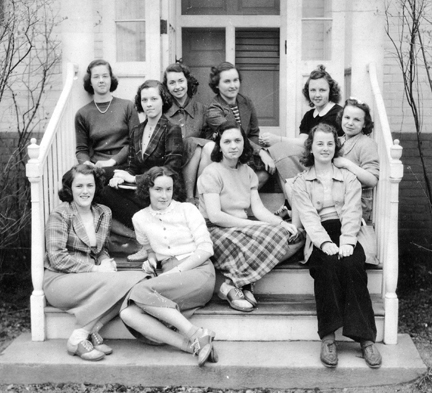
My mother (the farthest person to the right) and her friends at the French House at Mount Holyoke College in 1939.

On Mother’s Day—and on many other days of the year—I think fondly of my late mother. I often cook something she enjoyed making and eating.

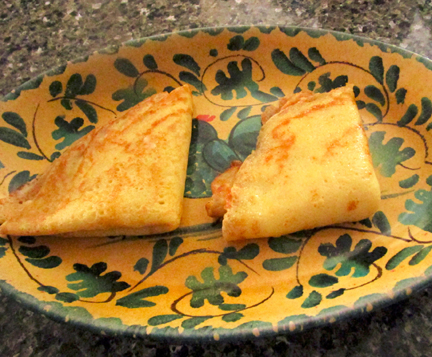
When I was planning today’s Mother’s Day appearance on Mass Appeal, I thought of my mother’s love of Paris, a love she passed on to me, and decided to make crêpes. This classic Parisian street food can be savory or sweet.

I’m not the world’s best crêpe maker. My crêpes aren’t perfectly flat and even. They are good enough, however—and they’re delicious!

My mother first fell in love with Paris and France on a trip there after her freshman year at Mount Holyoke, escorted (along with several other students) by a professor and his wife.

She happily went back to Paris for her junior year abroad, acquiring such a flawless Parisian accent that she was mistaken for a Frenchwoman. (My French was pretty darn good, but French people always knew I was American.) And she returned again and again throughout her life.

Here’s a paragraph she wrote in a diary in 1953, when she visited the city as a young mother and went to see a play at the Comédie-Française:

During the intermission I wandered into the lobby and delighted my soul further as I looked out through the colonnades at the fountains in front. I felt as tho I were re-finding Paris as I had loved it! And the life—the magnetic life of the city as I saw it again wandering through the streets, the narrow streets thronged with shops and people.

I like to think that my crêpes would have delighted her soul, too! I can’t replicate those shops and people, but I like to think that I can recreate a little taste of Paris in her honor.

Making the crêpes on Mass Appeal didn’t go QUITE as planned. Live TV is live TV. I had an egg mishap, and I never got to turn the darn things on camera. We had fun anyway—and the end product was delicious.

Happy Mother’s Day!

Classic Savory or Sweet Crêpes

Ingredients:

for the crêpes:

2 eggs
1 cup milk
1/2 teaspoon salt
1 cup flour
2 tablespoons melted butter
more butter as needed

for the fillings:

lots of butter
grated Gruyère or Jarlsberg cheese OR lemon juice and sugar

Instructions:

Place the eggs in a blender, and blend them to mix them. Add the milk, salt, and flour, and blend again on low speed. Blend in the melted butter.

Cover your blender bowl, and let the batter sit for at least 30 minutes before making the crêpes.

When you are ready to cook, melt a small amount of butter in an 8-inch nonstick frying pan over medium-low heat. Spread the butter around with a pastry brush or a paper towel.

Pour a few tablespoons of batter into the middle of the pan. Swirl the pan around to distribute the batter as well as you can into an even, flat pancake. Cook for a couple of minutes, until the bottom is light brown and the edges left up easily; then flip the crêpe and let it cook on the other side.

Remove the crêpe from the pan, and let it cool on a plate or rack. Continue until you have used up your batter.

You may fill your crêpes to make them either savory or sweet. For savory crêpes (known as galettes), melt butter in an 8- or 10-inch nonstick frying pan. Spread it around as you did for the crêpes. Place 1 crêpe on the pan, let it cook for a few seconds in the butter, and then flip it over. Sprinkle grated cheese on top, and let it melt for a minute or so; then fold the crêpe over the cheese to make a half circle. Cook until the cheese melts; then remove the galette from the heat. Repeat with the remaining crêpes.

The process for making sweet crêpes is similar, but instead of putting cheese on the inside you will sprinkle sugar and a small amount of lemon juice inside each crêpe.

Makes about 10 crêpes.

And now the videos:

Tinky Starts the Crêpes on Mass Appeal

Tinky Finishes the Crêpes (more or less)


Taffy’s Succotash

Tuesday, September 25th, 2012

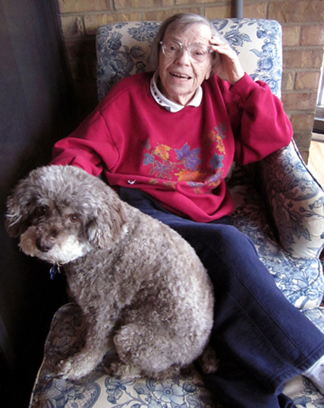
Taffy last year with the faithful Truffle (also a big fan of succotash!)

Tomorrow is my mother’s birthday. Jan Hallett Weisblat (a.k.a. Taffy) would have turned 94 this September 26. So naturally I’m thinking about her. And it’s only a small step from thinking about her to cooking her favorite dishes. Both the thoughts and the food make me smile.

Each year that I can remember she kept her eyes open in August and September for what she called “pink beans.” They are also known as cranberry beans; when I purchased them recently at Foster’s Supermarket in Greenfield, Massachusetts, they were labeled simply “shell beans.”

These fresh beans are encased in pink-and-white-mottled skins. When removed from their shells the beans themselves are also white with pink flecks, although they trade those colors for a less exciting uniform beige when cooked.

Whenever my mother saw them, she would buy them, take them home, and make succotash. I have a feeling the beans were grown on her grandparents’ farm when she was growing up because they represented home to her. Now they speak of home to me as well.

I made pink-bean succotash a couple of weeks ago in Taffy’s memory. She never actually measured the beans or the corn or the cream so the quantities below are approximate. If you want to dress up your succotash, add a little sautéed onion, some herbs, and/or a little bacon garnish. My mother never did so the recipe below is rather plain.

Its flavor is far from plain, however. The beans have a subtle but unmistakable nutty taste. When you throw in the corn and the cream (or half and half) and grind a small hill of pepper on top you end up with a dish fit for a queen.

The succotash embodies my mother’s ability to take joy in simple, everyday pleasures. If I can be half as joyful in my lifetime, I will count myself lucky.

Succotash à la Taffy

Ingredients:

2 cups shelled cranberry beans
2 cups water, plus more water as needed
salt to taste
the cooked kernels from 3 ears of corn
cream or half and half as needed (between 1/2 cup and 1 cup)
lots of freshly ground pepper

Instructions:

Pick over the beans, removing any that have turned brown.

In a medium saucepan bring the cranberry beans, water, and salt to a boil. Reduce the heat, and simmer until the beans are tender but not mushy. This will take between 15 and 45 minutes, depending on the age of the beans. (The younger they are, the less time it will take.)

Stir the beans from time to time while they simmer, and be sure to add more water if you need to. At the end of the simmering process the beans should still have a little—but not a lot of—liquid in their pan. Do not drain off this liquid.

Stir in corn and cream or half and half to taste. The beans should be in a gentle liquid bath but shouldn’t be drowning. Cook for another 5 minutes or so, until everything is heated through.

Grind pepper over the succotash and serve it. Serves 6 to 8 hearty eaters.

If you enjoyed this post, please consider taking out an email subscription to my blog. Just click on the link below!

Subscribe to In Our Grandmothers’ Kitchens by Email.

Messy But Good Birthday Cake

Monday, September 28th, 2009

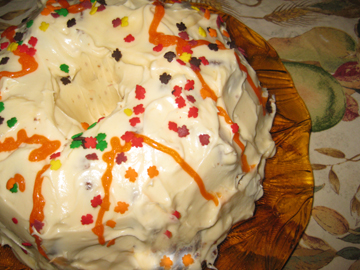
apple chocolate cake web

 
I may have mentioned before that presentation is NOT my forte.
 
Most of the things I make taste pretty good. Quite a few look … well, I guess the polite way to put it would be “homemade.”
 
The cake I baked for my mother’s birthday on Saturday was a case in point.
 
First I made a teensy (okay, a big) error in not making sure the pan was balanced in the oven. It tipped a bit as the cake baked, rendering the whole creation a little lopsided and not incidentally spilling batter onto the floor of the oven. My dog Truffle was NOT happy when the smoke alarm went off!
 
Next, I rushed through icing the thing. As a result, my lopsided cake was messier than ever.
 
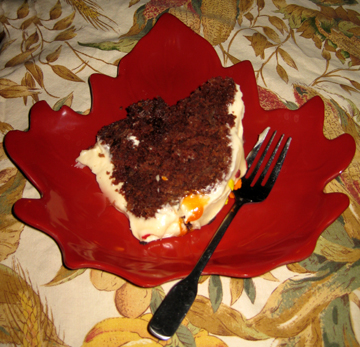
Luckily, I had some gel and sprinkle to cover up at least some of the mess. Even more luckily, the birthday girl and her guests were nice enough not to mention the way the cake looked. And of course it did taste fantastic–moist from the apples yet very cakelike.
 
I thought of taking a photo of Jan on her 91st birthday. Unfortunately, the idea didn’t enter my mind until nine o’clock that night. She had gone to bed at 8:30. This doesn’t mean she didn’t have a great birthday–only that she is indeed 91.
 
I do have pictures of her 90th birthday party on the blog post for THAT event.
 
Meanwhile, here’s the recipe. Do watch your placement of the pan in the oven. (To be extra sure, put a cookie sheet under it!) Read this article from Tony at Appliance Hunter for more oven tips.
 

Apple Chocolate Cake
 
If you want to increase the apple presence in this recipe, use the powdered buttermilk manufactured by SACO, available in many grocery stores. Add 2 tablespoons of buttermilk powder to the flour, cocoa, baking soda, and salt; then stir in 1/2 cup sweet cider when the recipe calls for the liquid buttermilk.
 
Ingredients:
 
2-1/2 cups flour
1/4 cup cocoa
1 teaspoon baking soda
1 teaspoon salt
1/2 cup (1 stick) sweet butter, at room temperature
1/2 cup canola oil
1-3/4 cups sugar
2 eggs
2 teaspoons vanilla
1/2 cup buttermilk
2 cups grated apple (about 2 medium apples)
 
Instructions:
 
Preheat the oven to 325 degrees. Sift together the flour, cocoa, baking soda, and salt, and set aside. Using an electric mixer at medium speed, cream together the butter, oil, and sugar in a mixing bowl until light and fluffy. Beat in the eggs, 1 at a time, beating well after each addition, and beat in the vanilla. Next, add the dry ingredients alternately with the buttermilk, blending well after each addition. Stir in the apple.
 
Pour the batter into a greased, 10-inch bundt pan. Bake for about 50 to 60 minutes, or until a toothpick inserted into the cake comes out clean. Cool the cake for ten minutes; then remove it from the pan, and let it cool completely before frosting with cream-cheese frosting. Topping the whole with seasonal sprinkles and/or candy corn is a plus. Makes 12 servings.
 
piece of apple cake web